


















HubSpot vs NetSuite CRM
Compare HubSpot vs NetSuite CRM on automation, scalability, and pricing. Discover which CRM suits your business best.
- Author
- Ruben Burdin · Founder & CEO
- Published
- Read time
- 5 min read
HubSpot vs NetSuite CRM : explore automation, reporting, and scalability. HubSpot leads in marketing automation and ease of use, while NetSuite CRM excels in ERP integration and financial data visibility. Learn which fits your organization and how to connect them for unified, real-time data.
Why Compare HubSpot and NetSuite CRM?
HubSpot and NetSuite CRM cater to different stages of business maturity. HubSpot focuses on marketing-driven growth and CRM simplicity, while NetSuite CRM integrates sales, finance, and ERP in one enterprise platform. Comparing them helps clarify whether you need marketing automation and usability (HubSpot) or financial and operational control (NetSuite CRM).
Understanding HubSpot CRM for Growth and Marketing Teams
HubSpot CRM offers a full suite of tools across Marketing, Sales, and Service hubs. Its no-code automation, contact management, and campaign tracking make it ideal for SMBs and mid-market companies. With an intuitive interface and modular pricing, HubSpot scales smoothly as your team grows.
NetSuite CRM for Enterprise Operations and ERP Integration
NetSuite CRM is part of Oracle’s ERP suite, designed for businesses that need unified sales, finance, and operations management. It integrates customer lifecycle management, forecasting, and financial visibility into one system. NetSuite excels at connecting CRM data with accounting, inventory, and fulfillment, perfect for companies scaling globally or managing complex operations.
HubSpot vs NetSuite CRM: Side-by-Side Comparison
| Category | HubSpot CRM | NetSuite CRM |
|---|---|---|
| Ease of Use | Intuitive; minimal setup | Complex; requires onboarding |
| Customization | Moderate; flexible workflows | Advanced; ERP-grade customization |
| Marketing Features | Full inbound automation suite | Limited marketing tools; ERP focus |
| Automation | Drag-and-drop workflows | Business logic automation via SuiteFlow |
| Integrations | 1,000+ native and third-party apps | Deep integration within NetSuite ERP ecosystem |
| Reporting & Analytics | Modern dashboards and attribution | Comprehensive operational and financial reporting |
| Pricing (2025) | Modular hubs; cost increases by tier | License-based; higher total cost of ownership |
| Best For | SMBs and mid-market marketing-led companies | Enterprises needing unified CRM + ERP control |
Key Takeaways
HubSpot CRM excels in usability, quick setup, and powerful marketing automation, ideal for SMBs and mid-market teams scaling inbound strategies.
NetSuite CRM offers deeper process control, advanced customization, and tight ERP integration, making it ideal for enterprises managing complex operations.
While HubSpot prioritizes ease of use and rapid adoption, NetSuite provides a unified CRM + ERP platform built for efficiency and financial alignment.
HubSpot vs NetSuite CRM: Pros and Cons Explained
HubSpot CRM
HubSpot is best known for its user-friendly design and marketing-led automation. It simplifies customer engagement while supporting scalable growth.
- ✓ Easy to use; quick setup; full marketing automation suite
- ✓ Free plan available with scalable paid hubs
- ✕ Limited ERP and finance integrations
NetSuite CRM
NetSuite CRM offers powerful enterprise capabilities, connecting sales, finance, and operations in one system.
- ✓ Unified ERP and CRM environment
- ✓ Deep financial and operational insights
- ✕ Higher setup complexity and licensing cost

HubSpot or NetSuite: Which CRM Fits Best?
- Choose HubSpot if you prioritize marketing automation, lead nurturing, and ease of adoption.
- Choose NetSuite CRM if you need ERP-level control, financial visibility, and end-to-end business management.
Integrating HubSpot and NetSuite?
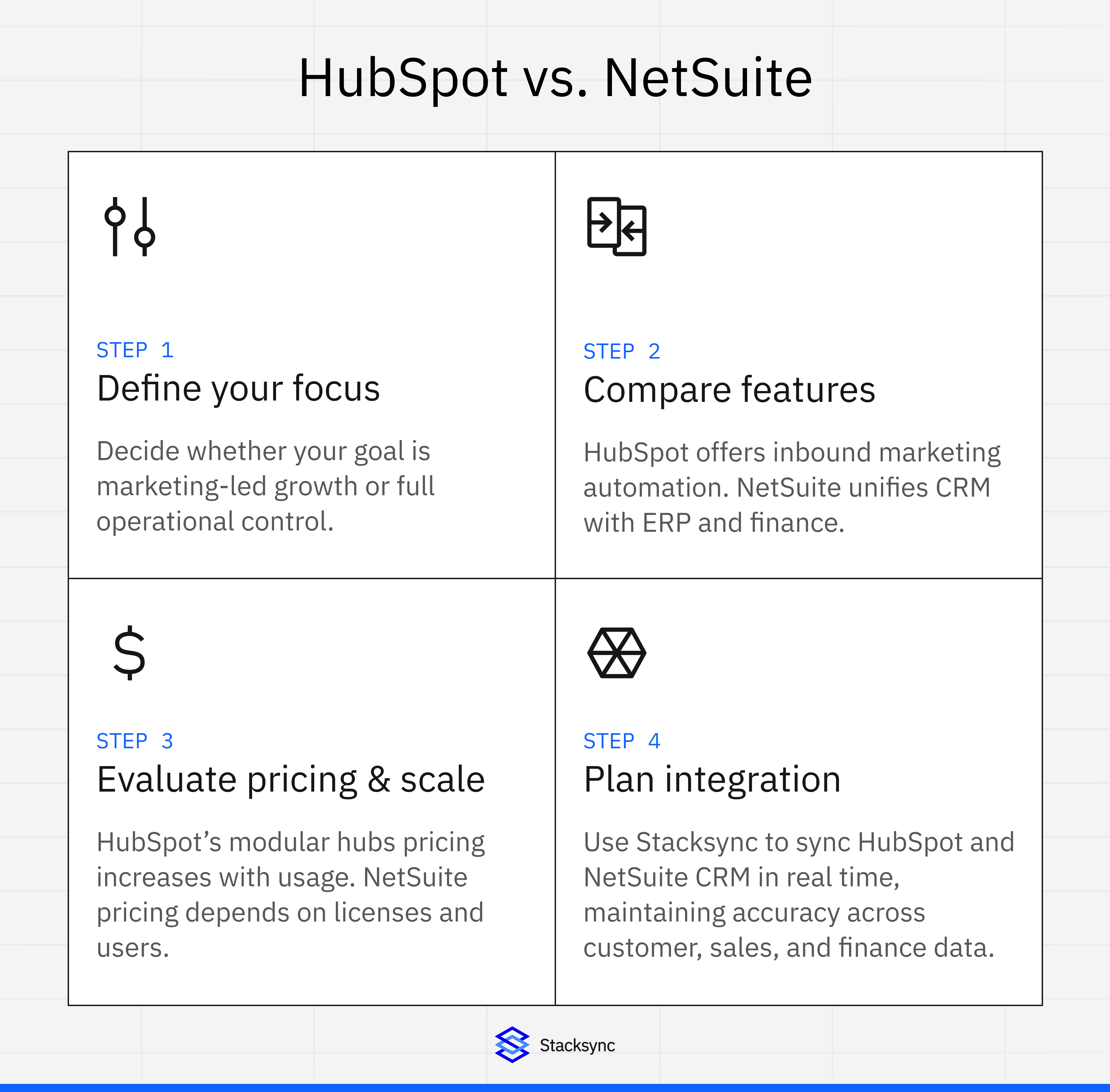
Many companies run both: HubSpot for marketing and sales, NetSuite for finance and operations. To keep customers, contacts and closed-won deals matched across the two, read the HubSpot NetSuite integration guide, which compares HubSpot's native integration, Celigo, Workato and two-way sync. For the objects each system can read and write, see the HubSpot and NetSuite integration page.
FAQ
Frequently asked questions










Related insights