What Changed: TikTok Shop Ends Seller Shipping in February 2026
TikTok Shipping means TikTok assigns the carrier and label; Seller Shipping means you handle it. See the difference, the 2026 changes, and compliance steps.
- Author
- Ruben Burdin · Founder & CEO
- Published
- Updated
- Read time
- 11 min read
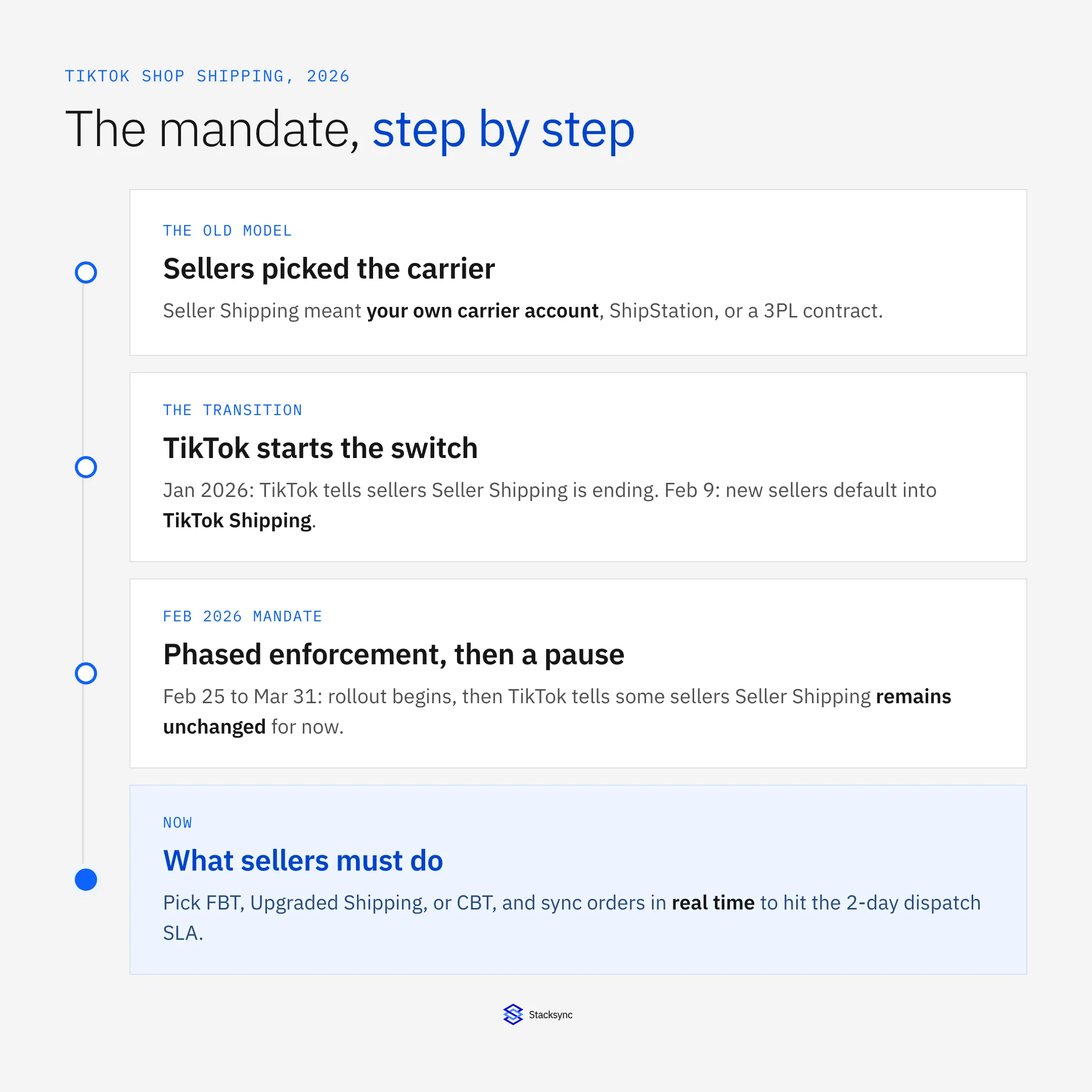
TikTok Shop announced that Seller Shipping will be discontinued for all US sellers starting February 25, 2026. By March 31, 2026, every order must flow through TikTok Shop Logistics Services. Sellers who relied on their own carrier accounts, ShipStation, or direct USPS labels no longer have that option.
Key Takeaways
- Deadline: Seller Shipping ends on February 25, 2026, with full enforcement starting March 31, 2026.
- Mandatory paths: Sellers must transition to Fulfilled by TikTok (FBT), Upgraded TikTok Shipping, or Collections by TikTok (CBT).
- Strict SLAs: Orders must be dispatched within two business days to keep the Late Dispatch Rate (LDR) below 4%.
- Integration challenge: Upgraded Shipping requires direct API connections, and manual processing does not scale for high-volume sellers.
- Solution: Stacksync enables real-time synchronization between TikTok Shop and existing WMS or ERP systems such as NetSuite or Salesforce.
This policy shift forces every US seller into one of three fulfillment paths: Fulfilled by TikTok (FBT), Upgraded TikTok Shipping, or Collections by TikTok (CBT). The change mirrors Amazon's fulfillment control model, where the platform manages the delivery experience end to end.
For sellers operating multi-channel businesses with established warehouse operations and 3PL partnerships, this creates an operational and financial challenge that extends well beyond picking a new shipping label provider. Stacksync has a basic connection to TikTok ready, supporting the latest TikTok features and updates available, meaning you can maintain your existing fulfillment infrastructure while meeting every new compliance requirement.
The Enforcement Timeline
The rollout follows a compressed schedule:
- February 9, 2026: New sellers onboarding after this date must use TikTok Logistics from day one
- February 25, 2026: Phased enforcement begins for existing sellers
- March 31, 2026: Seller Shipping fully discontinued across all US accounts
Sellers who fail to comply face order cancellations, performance penalties, decreased visibility, and potential account restrictions. The platform has made clear that non-compliance is not an option. Book a demo to see how Stacksync helps you meet TikTok Shop compliance without rebuilding your fulfillment stack.
The Three Fulfillment Paths and What Each One Means
TikTok Shop offers three logistics options, each with different operational implications and cost structures. Understanding the trade-offs is critical before committing to a path.
| Fulfillment Path | Best For | Key Benefit | Main Drawback |
|---|---|---|---|
| Fulfilled by TikTok (FBT) | Merchants seeking hands-off logistics operations. | “Free 3-Day Delivery” badge plus 20–35% savings on shipping costs. | Limited control over branding, packaging, and unboxing experience. |
| Upgraded TikTok Shipping | Multi-channel sellers already working with 3PL partners. | Retain existing warehouse operations with discounted TikTok shipping labels. | Requires more complex API integrations and setup effort. |
| Collections by TikTok (CBT) | High-volume sellers located near major fulfillment hubs. | Free warehouse pickup and up to 30% additional shipping discounts. | Very limited geographic availability. |
Key Takeaways
Fulfilled by TikTok maximizes convenience and conversion benefits but sacrifices brand control.
Upgraded TikTok Shipping offers flexibility for established sellers willing to manage technical complexity.
Collections by TikTok delivers strong cost advantages for high-volume sellers, though access is geographically constrained.
Why This Hits Multi-Channel Sellers Hardest
Sellers who operate across Shopify, Amazon, Walmart, and TikTok Shop built their fulfillment infrastructure around unified processes. One warehouse, one WMS, one set of carrier contracts serving all channels. TikTok's mandate fractures that model.
Integration Requirements That Break Existing Workflows
Upgraded TikTok Shipping requires direct API integration with TikTok's logistics system. Your fulfillment stack must:
- 01Pull orders from TikTok Shop automatically
- 02Generate TikTok-approved shipping labels through their API
- 03Push tracking numbers back to TikTok Shop
- 04Update order status to "In Transit" within 2 business days
TikTok currently approves a limited list of ERP systems for direct integration: AfterShip Shipping, 4Seller ERP, ECCANG, LINGXING ERP, LINGXING WMS, and ShipHero. If your system is not on that list, TikTok's guidance is to contact your ERP provider or process orders manually through Seller Center. Stacksync supports the latest TikTok features and updates available, extending integration to over 1,000 systems, including NetSuite, Salesforce, PostgreSQL, and custom databases. See how it works.
Manual Processing Is Not Scalable
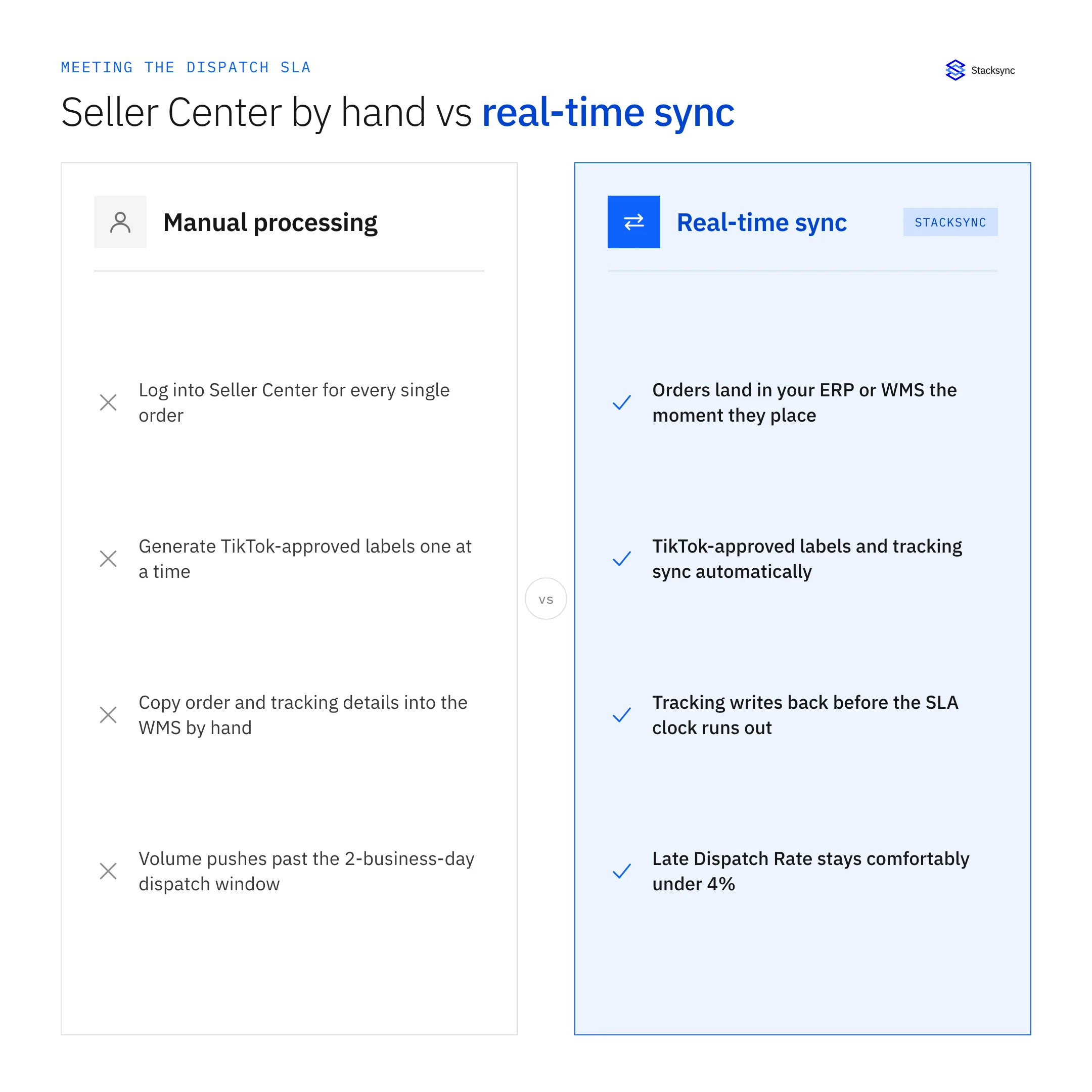
Processing orders manually through TikTok's Seller Center means logging in for every order, generating labels one at a time, copying order details into your warehouse system, and manually updating tracking numbers. For sellers handling hundreds of daily orders, this approach consumes entire teams and introduces error rates that trigger performance penalties.
The Late Dispatch Rate Penalty
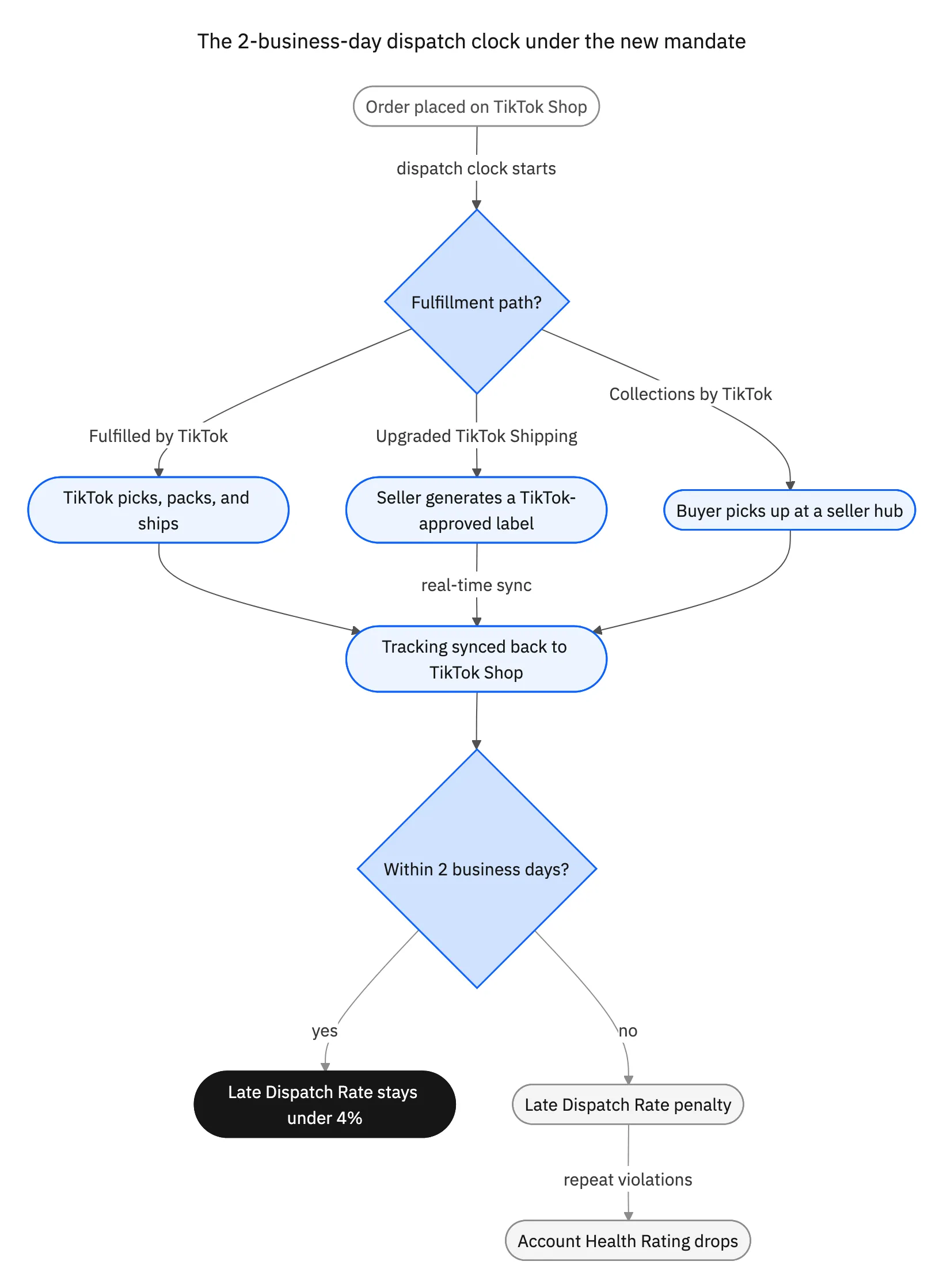
TikTok requires sellers to maintain a Late Dispatch Rate (LDR) below 4%. Orders must receive valid tracking numbers within 2 business days. Missing this threshold triggers Account Health Rating point deductions, decreased visibility, order volume limits, and extended settlement periods.
The penalty structure escalates with repeated violations. Sellers who fall behind on dispatch SLAs lose the metric exemptions that make Upgraded TikTok Shipping viable, creating a downward spiral of penalties and reduced sales. Real-time order synchronization eliminates the batch processing delays that push sellers past the 4% threshold.
Performance and Operational Risks on TikTok Shop
Beyond the financial pressure, the logistics mandate introduces operational risks that affect seller performance scores and platform standing.
Carrier Selection Is No Longer in Your Hands
Under Upgraded TikTok Shipping, TikTok selects the carrier for each order. Sellers cannot choose their preferred carrier or service level. If TikTok routes a package through a carrier with poor performance in certain regions, the seller bears the consequence through customer complaints and return rates.
Weight and Dimension Discrepancies
Sellers are responsible for any extra costs from weight or dimension discrepancies between what was declared and what the carrier measures. Inaccurate product data in your catalog can trigger unexpected surcharges that further erode margins.
Return Processing Complexity
TikTok Shop's consumer-friendly return policies generate return rates that vary by category. Returns processed through FBT follow TikTok's handling procedures. Returns under Upgraded TikTok Shipping go back to the seller's warehouse, adding labor and processing costs to an already tight margin structure.
What This Means for Different Seller Types
The impact of the logistics mandate varies significantly based on business model, scale, and existing infrastructure.
Small Sellers and Direct-to-Consumer Brands
Sellers operating from their own facilities face the choice between FBT (losing fulfillment control) and Upgraded TikTok Shipping (requiring API integration they may not have the technical resources to implement). For many, the cost of compliance exceeds the revenue generated on the platform. Stacksync's no-code configuration eliminates the need for dedicated engineering resources, making TikTok Shop integration accessible without technical overhead.
Mid-Size Sellers with 3PL Partnerships
These sellers face the most complex transition. Their 3PL must integrate with TikTok's API, which may not be on the approved list. The 3PL costs not covered by buyer shipping fees create margin pressure that requires repricing or absorbing losses. Switching 3PLs to one that supports TikTok integration means disrupting operations across all channels. Book a demo to see how Stacksync connects your existing 3PL to TikTok Shop without disrupting your multi-channel operations.
Enterprise and Multi-Channel Operations
Large sellers with custom ERP systems, multiple warehouses, and sophisticated fulfillment workflows need an integration layer that bridges TikTok's requirements with their existing infrastructure. The compressed timeline leaves limited room for system migrations or custom development. Stacksync delivers integration projects that traditionally take months in days, not weeks.

The Data Integration Challenge Behind the Logistics Mandate
The logistics mandate is fundamentally a data integration problem. Every TikTok Shop order must flow through systems that talk to each other in real time: order management, warehouse management, carrier APIs, and TikTok's logistics platform.
Why Real-Time Data Matters for TikTok Shop Compliance
The 2-business-day dispatch SLA leaves no room for batch processing delays. When an order comes in on TikTok Shop, your fulfillment system needs to see it immediately, generate the correct label, and push tracking information back to TikTok before the clock runs out.
Batch-oriented integrations that sync orders every 15, 30, or 60 minutes create dispatch windows where orders sit unprocessed. During peak demand periods, these delays compound and push sellers past the 4% Late Dispatch Rate threshold. Stacksync provides sub-second synchronization that eliminates these processing gaps entirely.
Inventory Accuracy Across Channels
Sellers operating on multiple platforms need inventory counts that reflect reality across all channels simultaneously. When a product sells on TikTok Shop, that inventory change must propagate to Shopify, Amazon, and your warehouse system within seconds, not minutes.
Overselling on TikTok Shop triggers cancellations that count against seller metrics. Underselling means lost revenue during demand spikes. The tolerance for inventory lag on a platform with strict performance requirements is effectively zero.
Order Routing and Fulfillment Orchestration
Multi-warehouse sellers need orders routed to the correct facility based on inventory availability, proximity to the customer, and carrier coverage. This routing must happen automatically and immediately when the order arrives from TikTok Shop.
Manual routing introduces delays that eat into the 2-day dispatch window. Automated routing requires your systems to share real-time data about inventory levels, warehouse capacity, and fulfillment status across every connected platform. Stacksync's workflow automation handles triggered actions like order routing, inventory adjustments, and status updates automatically, with no manual intervention required.
How Stacksync Connects TikTok Shop Data to Your Existing Systems
Stacksync has a basic connection to TikTok ready, supporting the latest TikTok features and updates available. This means sellers can integrate TikTok Shop data with their existing operational infrastructure without rebuilding their fulfillment stack.
Real-Time Order and Inventory Synchronization
Stacksync provides sub-second, bi-directional data synchronization between TikTok Shop and the systems sellers already use. When an order arrives on TikTok Shop, Stacksync routes it to your ERP, WMS, or database instantly. When inventory changes in your warehouse, TikTok Shop reflects that update within seconds.
This eliminates the batch processing windows that create dispatch SLA violations and inventory mismatches. Your existing fulfillment workflows continue unchanged while Stacksync handles the data movement between TikTok and your operational systems.
Connecting Systems TikTok Does Not Natively Support
TikTok's approved integration list covers a handful of ERP systems. Stacksync extends that reach with over 1,000 pre-built connectors spanning CRMs, ERPs, databases, and SaaS applications. Whether your operations run on NetSuite, Salesforce, PostgreSQL, Snowflake, or custom databases, Stacksync bridges the gap without requiring you to migrate to a TikTok-approved system.
Multi-Channel Data Consistency
For sellers operating across multiple platforms, Stacksync maintains data consistency across all connected systems. Inventory updates from your warehouse propagate simultaneously to TikTok Shop, Shopify, Amazon, and any other connected channel. Order data from all platforms flows into your central system for unified processing.
This approach solves the fundamental problem the logistics mandate creates for multi-channel sellers: keeping every system synchronized in real time without adding manual processes or building custom integrations for each platform.
No-Code Setup and Workflow Automation
Stacksync's no-code configuration means sellers can set up TikTok Shop integration without dedicated engineering resources. Field mapping between TikTok's data model and your existing systems happens through a visual interface. Workflow automation handles triggered actions like order routing, inventory adjustments, and status updates automatically.
For sellers who built their operations over years and face a compliance deadline measured in weeks, this implementation speed matters. Integration projects that traditionally take months can be operational in days. Book a demo to see how Stacksync delivers TikTok Shop compliance without rebuilding your fulfillment stack.
Keep Your Fulfillment Stack and Meet TikTok Shop Compliance
TikTok Shop's logistics mandate represents a significant policy shift, but compliance does not require replacing your fulfillment infrastructure. The sellers who navigate this transition successfully will be those who add an integration layer that connects TikTok's requirements to their existing operations, rather than rebuilding from scratch.
The core challenge is data: getting orders from TikTok Shop to your warehouse in real time, keeping inventory accurate across all channels, and pushing tracking information back before dispatch SLAs expire. That is a synchronization problem, not a fulfillment problem.
Explore how Stacksync delivers real-time, bi-directional synchronization between TikTok Shop and your existing ERP, WMS, or database, keeping your fulfillment operations intact while meeting every compliance requirement. Stacksync supports the latest TikTok features and updates available so you stay compliant as the platform evolves.

FAQ
Frequently asked questions










Related articles