


















The CEO Who Said He Didn't Want the Job: The Origin Story of Mixpanel
Mixpanel's origin story: how 19-year-old Suhail Doshi and Tim Trefren built the event-analytics pioneer, then nearly lost it and rebuilt it profitably.
- Author
- Ignacio Malpartida · GTM Engineer
- Published
- Updated
- Read time
- 15 min read

The Year the Music Stopped
In 2017, Suhail Doshi sat in a company he had started at nineteen years old and did not want to run anymore.
He had built one of the most influential analytics platforms in Silicon Valley. He had raised $77 million from some of the most respected investors in the business. He had 8,000 customers. He had Uber. He had Airbnb. He had Netflix. He had a product that had changed how the software industry thought about data. He had done, by any external measure, exactly what a founder is supposed to do.
And he was miserable.
The company had ballooned to over 350 employees. It had moved upmarket, chasing enterprise deals with long sales cycles and custom contracts and procurement committees that took nine months to say yes. It had hired sales leadership and marketing leadership and customer success leadership and account management leadership. It had become, in the way that startups become things without ever deciding to, a company.
Doshi had stopped building. He was now managing. And managing, it turned out, was not what he was good at — or what he wanted to be good at.
He would later write, in a blog post that became one of the more read confessionals in startup history: he had never wanted to run Mixpanel. He had wanted to build it.
Those are different things. The difference cost him three years and nearly cost him the company.
This is the story of what happened in those three years. It is also the story of what Mixpanel is, how it was born, why it mattered, and why the question it answered in 2009 — what did the user actually do? — is still, fifteen years later, one of the most important questions in software.
A 19-Year-Old at USC Asks a Better Question
The year is 2009. Suhail Doshi is a junior at the University of Southern California. He is not a typical computer science student. He is consuming everything — code, product, business, design — with the kind of appetite that doesn't have a name in a university catalog. His co-founder, Tim Trefren, is a fellow student at USC, quiet and technically precise in the way that complements someone like Doshi, who is fast and loud and argumentative in the best way.
They are building software. Every startup and tech company of that era is building software. And every one of them is measuring it the same way: Google Analytics.
Google Analytics, by 2009, had conquered the web analytics market so completely that it had become furniture. You installed it on your site, you got a dashboard, you watched the number of visitors go up or down, and you made decisions based on that. Page views. Sessions. Bounce rate. Time on site.
The problem — and Doshi and Trefren saw this with the clarity that only comes from actually building products — is that page views tell you almost nothing about what your software is doing.
A page view is a camera pointed at the front door. It tells you someone walked in. It does not tell you whether they found the kitchen, tried the stove, burned the toast, and left forever. It does not tell you whether they came back. It does not tell you that seventeen percent of your users are dropping off at step three of your signup flow because the button is in the wrong place. It does not tell you that the users who complete onboarding are three times more likely to convert than those who don't — and that the onboarding completion rate is collapsing.
Page views tell you traffic. They do not tell you behavior.
Doshi and Trefren built an event-based analytics model. Not sessions. Not page views. Events. Every discrete action a user takes — signed up, uploaded file, clicked button, completed checkout, invited teammate, cancelled subscription — becomes a data point. String those data points together and you don't have traffic; you have a story. You have a movie of your product, frame by frame, user by user, with the ability to pause it at any moment and ask: what happened here?
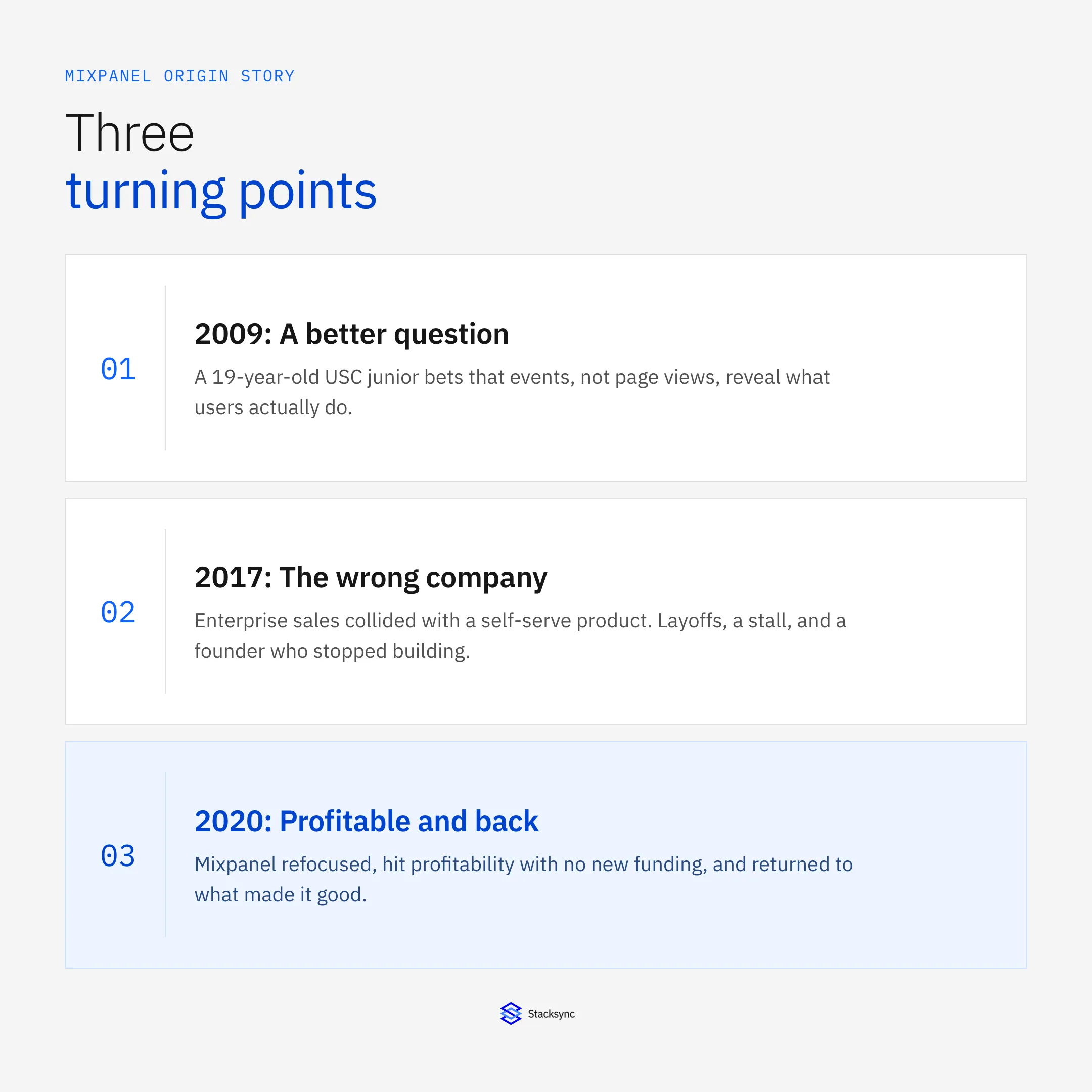
The instrument they built was called Mixpanel. They launched it from USC. They applied to Y Combinator in the summer of 2009.
Doshi was nineteen years old. He was, by several accounts, one of the youngest founders ever admitted to a YC batch. Paul Graham's program was four years old. It had already launched Dropbox, Loopt, and Reddit. It was becoming the most powerful filter in early-stage startups, and it was about to bet on a teenager who believed the entire web analytics market had been asking the wrong question.
They got in.
Building a Philosophy, Not Just a Product
The earliest days of Mixpanel were not about features. They were about argument.
The idea that you should track events rather than page views sounds obvious in 2024. It was not obvious in 2009. The web was still fundamentally document-based in how it thought about itself — you navigated between pages, and analytics measured pages. Google Analytics had trained an entire generation of builders to see their product as a collection of pages rather than a system of behaviors.
Mixpanel's thesis required customers to rethink something they had never thought to question.
The pitch was: you need to instrument your product. You need to tell us, explicitly, every meaningful thing a user can do. Every button click. Every form submission. Every moment that matters in your user's journey. You cannot just drop a script tag on your site and get insights; you have to decide what questions you want to answer before you start collecting data.
This was more work. It required product thinking before analytics thinking. Many companies didn't want to do it.
The ones who did discovered something that changed how they built.
Funnel analysis was the feature that made it real. A funnel is simple in concept: you define a sequence of events — Step 1, Step 2, Step 3, Step 4 — and Mixpanel shows you how many users complete each step and where they fall off. A checkout funnel. A signup funnel. An onboarding funnel. You could see, not just that thirty percent of your users weren't converting, but exactly where they were leaving — and at what point in the product flow the floor was collapsing beneath them.
It sounds obvious. In 2009, it was revelatory.
Engineers and product managers who used Mixpanel for the first time described the experience in roughly the same terms: like turning on a light in a dark room you'd been walking around in for years. You had been guessing, and now you weren't. The data was granular enough to act on. The questions it could answer were the right questions.
The product found traction fast. The customers who mattered — the builders, the scrappy product teams, the engineers who cared about what their product actually did — passed it around the way good tools get passed around: with the quiet insistence of people who feel they've found something nobody else has yet.
By 2012, Mixpanel had raised its first significant funding from Sequoia Capital. By 2014, it raised a $65 million Series B led by Andreessen Horowitz. The valuation at that round: $865 million. The ARR by 2016: approximately $65 million. The headcount: over 350 people.
Suhail Doshi was twenty-six years old and running a company worth nearly a billion dollars.
And somewhere in that growth, something had gone wrong.
What Happens When You Build the Wrong Company
The error was not dramatic. There was no single bad decision, no catastrophic hire, no bet-the-company product failure. Mixpanel's near-death experience between 2017 and 2019 was slower and more insidious than that: it was the result of doing everything that VC-backed companies are supposed to do, and discovering that those things were antithetical to what had made Mixpanel good.
The company had gone upmarket. The logic was straightforward: enterprise customers have bigger contracts, longer relationships, lower churn. If you can close the Fortune 500, you have durable revenue. So Mixpanel built a sales team. It built an enterprise product. It built the organizational infrastructure — customer success managers, account executives, solutions engineers — of a company selling to procurement departments instead of product teams.
The problem was that Mixpanel had been built by and for product teams. Its DNA was self-serve. Its earliest and best customers were builders who discovered it, instrumented their apps, and spread it through their companies the way good tools spread: because they worked, because they made you look smart, because the colleague who used it on their last project wouldn't stop talking about it.
Enterprise sales worked against this. It required a different product posture, a different pricing model, a different relationship with complexity. It required slowing down the thing that had been fast. It required adding overhead to something that had succeeded precisely because it was frictionless.
Growth stalled. Not catastrophically. The company was not collapsing, but the hockey stick had flattened. Competitors were moving. Amplitude, founded in 2012 by Spenser Skates and Curtis Liu after they pivoted from a music app, had built essentially the same product-analytics vision and was executing with the urgency of a company that had not yet stopped to run enterprise sales. The product analytics market was bifurcating, and Mixpanel was caught between its original identity and the enterprise posture it had tried to grow into.
In 2017, the company laid off roughly sixty people — around seventeen percent of its workforce. The official framing was reorganization. The reality was more complicated.
Doshi would later describe this period with the kind of honesty that founders almost never deploy while the company is still standing. He acknowledged, in writing, that he hadn't wanted to run the company. That he hadn't been built for management at the scale Mixpanel had grown to. That the gap between the thing he was good at — building product, thinking about problems, arguing about what users actually needed — and the thing a CEO of a 350-person company is supposed to do had become a chasm he didn't know how to cross.
What happened next was unusual. Instead of stepping down, he stepped back. Tim Trefren, the quiet engineer who had been there since USC, took on more operational control. Amir Movafaghi, who would eventually become CEO, entered the picture. The management layer that Doshi was not equipped to run was staffed by people who were.
And Doshi went back to the product.
Profitable, Private, and Proud of It
The decision that turned Mixpanel around was a decision to stop trying to be what the market expected and start being what it had originally been.
The company cut its cost structure. It reduced headcount. It got lean in the way that companies get lean when they realize that headcount is not the same as progress. It stopped trying to close enterprise deals with eighteen-month cycles and started asking a simpler question: could the product sell itself?
The answer, it turned out, was yes — if the product was good enough and the onboarding was simple enough and the pricing was honest enough. Product-led growth had a name by 2018; Mixpanel had been a product-led company before the terminology existed. The task was returning to that original posture.
In September 2020, Mixpanel did something almost no VC-backed SaaS company does: it publicly declared that it had become profitable. The announcement landed with a particular resonance in an industry accustomed to companies burning their way toward scale and hoping the math would eventually work. Mixpanel had done the opposite. It had burned, stalled, cut, and rebuilt — and the rebuilt version made money.
The profitability announcement covered fiscal year 2019. Mixpanel had reached profitability during the same year Doshi had been publicly wrestling with his role in the company. The turnaround had taken roughly two years from the 2017 restructuring.
Seven years had passed since Mixpanel's Series B. Seven years in which the company had not raised a dollar. In an industry that treated funding rounds as proof of health, this was either a sign of distress or a sign of discipline. By 2020, with the profitability announcement, the narrative shifted to discipline.
In November 2021, Mixpanel raised $200 million in a Series C from Bain Capital Tech Opportunities. The valuation was $1.05 billion. The company had crossed back over the unicorn threshold, not through the blitzscaling playbook, but through the harder and less celebrated path of actually figuring out how to run a profitable business.
| Year | Milestone | Detail |
|---|---|---|
| 2009 | Founded at USC, joins Y Combinator | Suhail Doshi (19) and Tim Trefren; event-based analytics; YC Summer 2009 batch |
| 2012 | First major funding | Led by Sequoia Capital |
| 2014 | Series B | $65M led by Andreessen Horowitz; ~$865M valuation |
| 2016 | Scale | ~$65M ARR; 350+ employees |
| 2017 | Restructuring | ~60 layoffs (~17% of staff); refocus away from enterprise |
| 2019 | Reached profitability | During the turnaround; no new funding raised since 2014 |
| 2020 | Announced profitability (Sept) | Covering fiscal year 2019 |
| 2021 | Series C (Nov) | $200M from Bain Capital Tech Opportunities; $1.05B valuation |
| 2025 | Today | 8,000+ customers (OpenAI, Netflix, Uber, Pinterest); ~410 employees; still private |
Mixpanel funding and milestones

The Market They Built, and the War They're Still In
The product analytics market that Mixpanel and Amplitude both inhabit is worth, depending on who you ask and how they're counting, somewhere between $10 billion and $50 billion in addressable value. It is, structurally, an infrastructure layer: every company building software needs to understand what that software does when real people use it.
Amplitude went public in September 2021 via a direct listing, not a traditional IPO. The market valued it at approximately $6.2 billion on day one of trading. Amplitude had scaled aggressively, raised more than $300 million in venture capital, and built a broader platform than Mixpanel — adding experimentation tooling, data management features, and a CDP. Its path was the classic hypergrowth playbook.
Mixpanel's path was the opposite: survive, refocus, become profitable, raise strategically, stay private.
Both approaches led to unicorn valuations. Both companies remain dominant in the product analytics conversation. The rivalry between them is the professional equivalent of a long-running argument about what kind of company you want to be.
By 2025, Mixpanel served over 8,000 customers globally — including OpenAI, Netflix, Pinterest, Uber, CNN, Samsara, and Yelp. The company had approximately 410 employees, offices on three continents, and a product that had evolved significantly from the funnel dashboards that had made it famous in 2011.
Suhail Doshi remained at the company. Not as the frantic twenty-year-old arguing about event-based analytics, not as the reluctant manager of a 350-person org, but as something closer to the architect he had always been: a person who believed the question "what did the user do?" is one of the most important questions in building software, and who had spent fifteen years building better and better tools to answer it.
The blog post he eventually wrote — the honest one, the one about not wanting to run the company, about the things he'd learned and the things he'd gotten wrong — became widely read not because it was unusual for a founder to struggle, but because it was unusual for a founder to say so out loud, at length, while the company was still standing.
Five Things Most People Don't Know About Mixpanel
1. Suhail Doshi was 19 years old when Mixpanel got into Y Combinator — making him one of the youngest founders in YC's history at the time.
He had not yet turned twenty when he and Tim Trefren went through the Summer 2009 batch. Y Combinator was four years old. Paul Graham had not yet written the essay on doing things that don't scale. The cohort that came through that summer was among the most formative in YC's history, and at the center of it was a USC junior who believed Google Analytics was philosophically wrong.
2. The profitability announcement covered a gap of seven years between funding rounds — the longest drought of any comparable SaaS company at the time.
Between the 2014 Series B and the 2021 Series C, Mixpanel raised nothing. In an industry where eighteen-month funding cycles were considered normal, this was nearly unheard-of. The company survived, restructured, and became profitable entirely without outside capital. When it raised again, the terms were on its terms.
3. The 2017 layoffs were not a failure announcement — they were a philosophy announcement.
Mixpanel did not cut seventeen percent of its workforce because the product had failed. It cut because it had grown in a direction that contradicted its original thesis. The implicit message was: we built an enterprise sales machine on top of a self-serve product, and those two things don't coexist. The restructuring was the company deciding to be one thing instead of two.
4. Doshi's public admission that he "didn't want to run the company" is one of the most honest things ever written by an active CEO about their own company — and he wrote it while remaining CEO.
Most founder confessionals are written post-exit, post-acquisition, or post-failure. Doshi wrote his while Mixpanel was still his. He described the exhaustion, the mismatch between his skills and the job's demands, and the specific ways the company had drifted from what he was good at. He then stayed and helped fix it. That arc — admitting failure while still in it, then continuing — is rarer than the failure itself.
5. Amplitude and Mixpanel are, at their core, built on the same insight — and the founder of Amplitude cited Mixpanel explicitly as the model he was building against.
Spenser Skates has described Mixpanel as the product that proved the market existed. The "Mixpanel vs Amplitude" debate that dominates product analytics conversations is not a debate about whether event-based analytics matters; it's a debate about execution approach, platform breadth, and pricing model. Mixpanel invented the category. Amplitude industrialized it. Both are still here. That's the rarest kind of competitive outcome: a market large enough that the company that created it and the company that ate most of its growth can both be worth a billion dollars.
Sources: Y Combinator company profile, Crunchbase funding records, TechCrunch coverage (2021), Built In company profile, Mixpanel official about page, Suhail Doshi's public writing, industry reporting on the product analytics market.

FAQ
Frequently asked questions