


















When Your Supabase Startup Needs Enterprise Integration
Recognize the 7 signs your scaling startup has outgrown manual workflows and custom scripts. Add enterprise integrations without sacrificing dev velocity.
- Author
- Ruben Burdin · Founder & CEO
- Published
- Updated
- Read time
- 5 min read

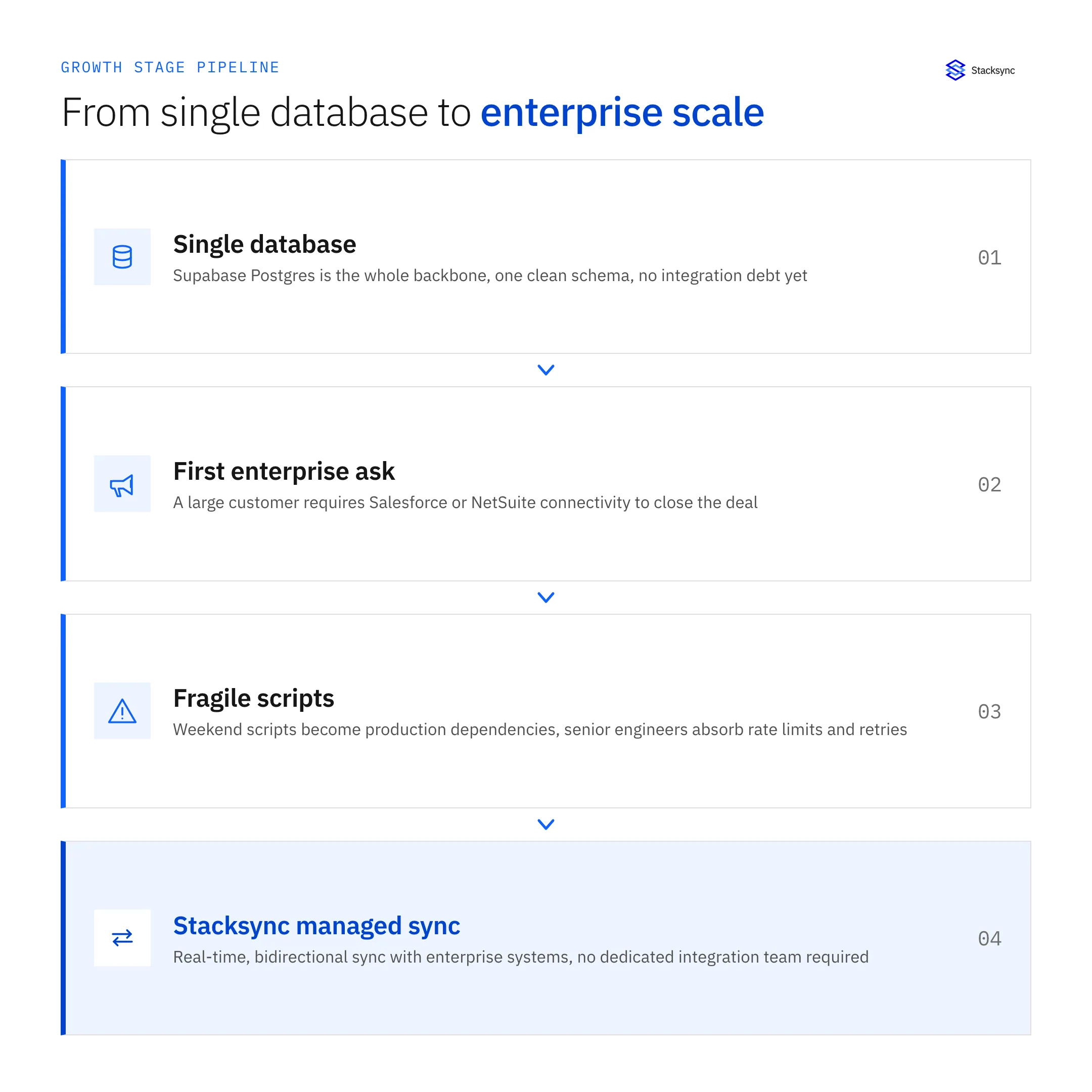
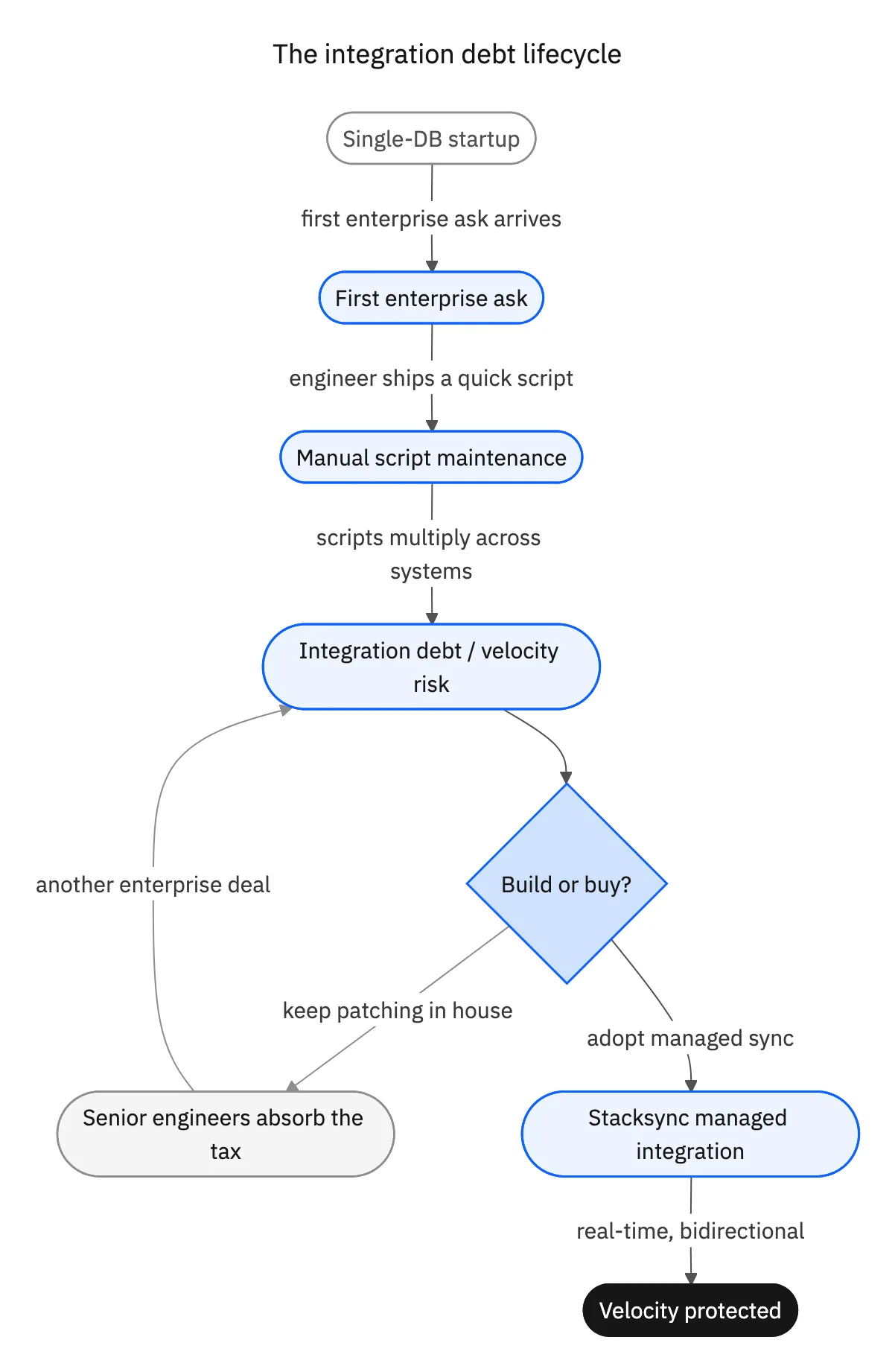
Every successful Supabase startup hits the same wall. What begins as a clean, single-database architecture eventually collides with enterprise reality. A large customer asks for Salesforce or NetSuite integration. RevOps flags that engineers are spending weeks maintaining fragile scripts. Developer velocity slows, even as revenue grows.
This guide helps founders and engineering leaders recognize the exact moment when integration debt stops being a nuisance and starts becoming a growth risk, and how to add enterprise integration without sacrificing speed.
The Deceptive Simplicity Trap
Most teams reach about 80 percent of integration functionality very quickly. A basic HubSpot sync works. Data flows. Everyone celebrates.
The remaining 20 percent is where things break.
Production grade integration requires reliable retries, schema evolution handling, conflict resolution, monitoring, and auditability. Achieving that level of reliability typically takes months, not days. Maintaining it consumes 30 to 50 percent of senior engineering time year after year.
As product market fit improves, this debt grows faster. Success accelerates complexity.
The Seven Signals You Have Outgrown Scripts
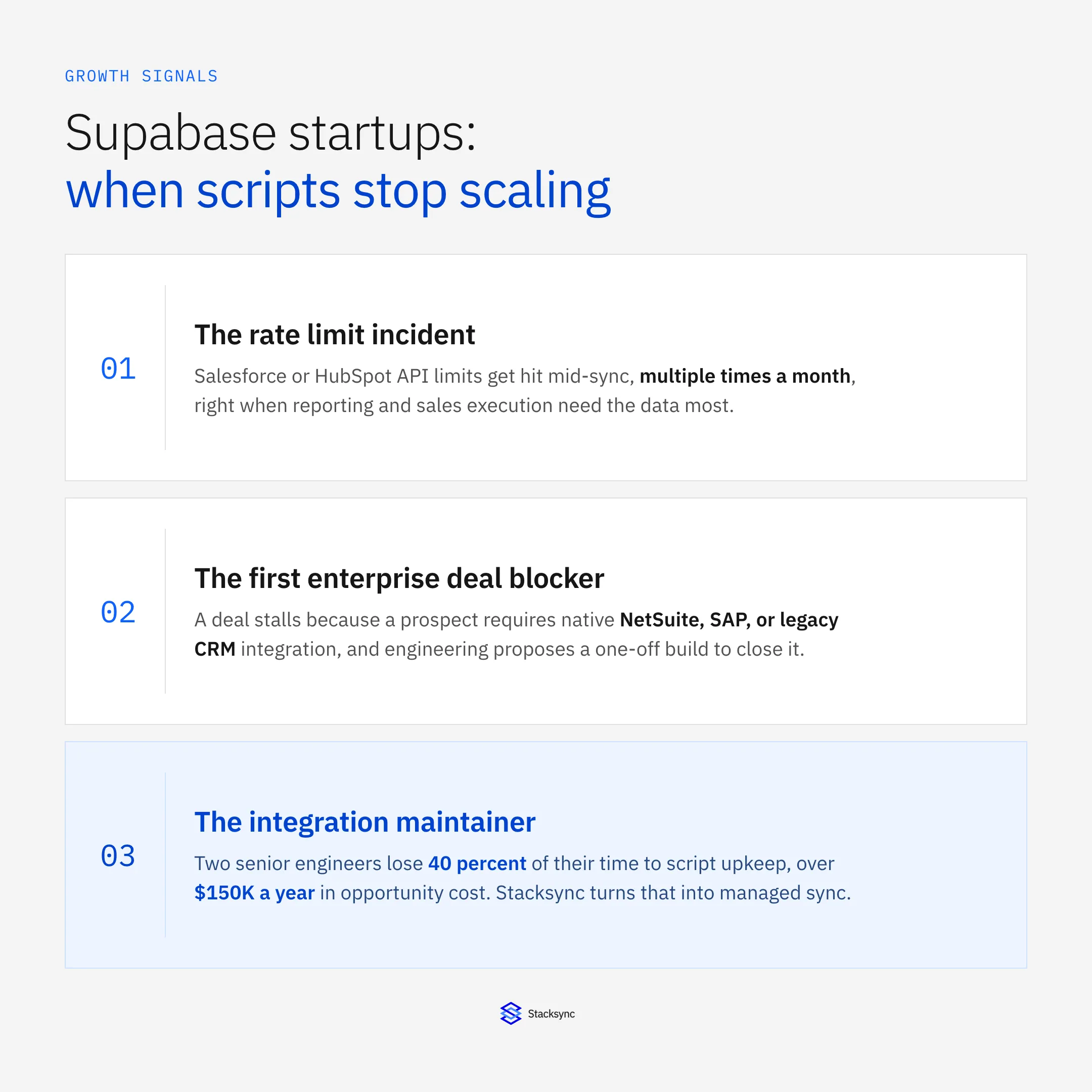
1. The Rate Limit Incident
Your product experiences production issues because Salesforce or HubSpot API limits are hit during syncs. This happens multiple times per month and directly impacts reporting and sales execution.
This signal means your integration is no longer experimental. It is now business critical.
2. The First Enterprise Deal Blocker
A deal stalls or is lost because a prospect requires native integration with NetSuite, SAP, or a legacy CRM. Engineering proposes building a one off integration to close the deal.
This is usually the first sign that custom integrations will not scale with revenue.
3. The Engineer as Integration Maintainer
You consider hiring someone whose primary responsibility is maintaining integrations. Two senior engineers spending 40 percent of their time on this work represents well over $150K per year in opportunity cost.
At this point, integration is infrastructure, not innovation.
4. The Manual Data Entry Rebellion
Sales Ops or RevOps teams manually update data between Supabase and CRM every day. Error rates creep up. Forecasts lose credibility. Teams stop trusting dashboards.
Manual work is a clear signal the system has exceeded its limits.
5. The Onboarding Velocity Crisis
Every new enterprise customer requires weeks of custom integration work. Engineering becomes a bottleneck in the sales process.
When onboarding speed slows, growth slows with it.
6. The Multi System Complexity Wall
You need to sync Supabase across three or more systems such as CRM, ERP, support, and analytics. Point to point scripts multiply and breaking changes cascade across the stack.
This is the point where duct tape architectures fail.
7. Real Time Becomes Non Negotiable
Your product requires instant reactions to usage data. Sales triggers, support escalations, or revenue workflows cannot wait for overnight jobs.
Batch processing no longer supports how the business operates.
The Growth Stage Pattern
Across hundreds of scaling SaaS companies, the pattern is consistent.
Early stage teams can survive with scripts. Mid stage companies feel increasing drag. Growth stage companies face real revenue risk if integration is not professionalized.
The decision is not whether to integrate. It is whether to keep paying the hidden tax or replace it with purpose built infrastructure.
The Developer Velocity Paradox
Great developers want to build differentiated product features. Integration maintenance demands the opposite. Debugging pagination edge cases, handling flaky sandboxes, and maintaining SOAP clients drains morale.
When engineers spend 40 percent of their time on plumbing work, attrition risk rises sharply. Replacing a senior engineer costs far more than buying reliable integration infrastructure.

Build Versus Buy for Supabase Teams
Supabase startups have a unique advantage. PostgreSQL is already an ideal integration hub. SQL provides expressive joins, strong consistency, and familiar workflows.
The real decision is whether to build and maintain the integration layer yourself or extend Supabase with infrastructure designed for this purpose.
Build in house only if integration is your core differentiator and you are willing to staff a dedicated team long term.
Buy when integration is undifferentiated infrastructure and engineering time is better spent on product innovation.
A Velocity Preserving Path Forward
Modern teams are increasingly pairing Supabase with Stacksyncto solve this problem cleanly.
Supabase remains the operational database and product backbone. Stacksync adds real time, bidirectional synchronization with enterprise systems like HubSpot, NetSuite, Zendesk, and data warehouses.
Together, Supabase and Stacksync allow teams to treat enterprise integration as infrastructure rather than custom code.
Teams typically see a clear rollout path:
A proof of concept in days, not months. Production ready sync within weeks. Expansion to additional systems without rewriting integrations or slowing development.
This approach consistently delivers up to 90 percent reduction in integration maintenance time while preserving the SQL first developer experience teams chose Supabase for.
The Moment to Act
If your Supabase startup is closing enterprise deals, onboarding complex customers, or seeing engineers buried in integration work, this is not a temporary phase.
Integration debt compounds with success. Addressing it early protects developer velocity, revenue growth, and team morale.
Supabase gives startups speed. Stacksync lets that speed survive enterprise scale.

FAQ
Frequently asked questions










Related articles