

















Change Data Capture for Supabase: Real-Time Sync Guide
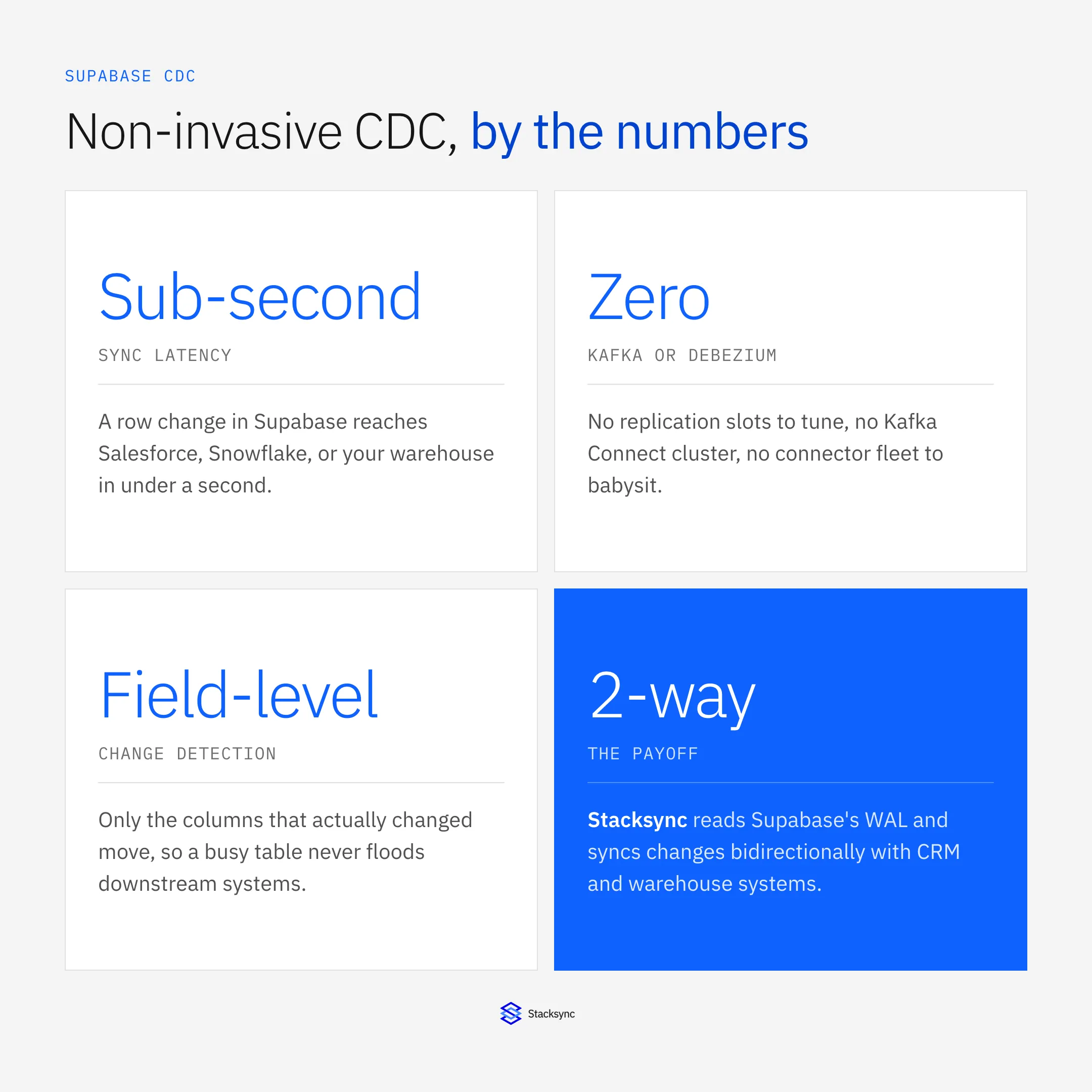
Implement non-invasive CDC for Supabase without Debezium or Kafka. Stream database changes to Salesforce, Snowflake, and warehouses with sub-second latency.
- Author
- Ruben Burdin · Founder & CEO
- Published
- Updated
- Read time
- 7 min read
Change Data Capture (CDC) lets you stream database changes from Supabase in real time, so systems like Salesforce, Snowflake, and operational apps stay consistent within seconds. The challenge is that traditional CDC often requires Kafka, Debezium, and database-level changes. This guide shows a non-invasive CDC approach for Supabase that delivers sub-second latency without running a distributed systems project.
Why CDC Becomes a Crisis at Scale
CDC is one of the most powerful patterns in modern data architecture, but it is also one of the easiest to underestimate.
Supabase is built on PostgreSQL, which has native CDC building blocks through WAL and logical replication. That theoretical capability often creates a false sense of simplicity. Many teams discover too late that turning those primitives into production-grade CDC introduces a full operational stack.
When CDC is implemented poorly, it is not just “a data issue.” It becomes a trust issue. Stakeholders stop believing dashboards, finance numbers diverge across systems, and engineers end up on weekend reconciliation duty.
The Silent Failure Problem
CDC pipelines can fail quietly. Connectors hang. Queues drop messages. Lag increases slowly. Meanwhile, systems appear “mostly synced” until a quarter-end reconciliation exposes weeks of divergence.
Recovering from CDC-induced data corruption is expensive:
- Manual reconciliation across systems
- Point-in-time restores and replays
- Executive escalations when financial and CRM data disagree
This is why a CDC strategy should prioritize observability, replay, and correctness over cleverness.
Why CDC Matters More Than Ever
CDC is no longer just a data engineering convenience. Three trends made it core infrastructure for modern Supabase applications.
Operational analytics replaced batch reporting
Modern businesses need closed-loop workflows where insights trigger action immediately:
- Usage spikes in Supabase trigger an upsell sequence in HubSpot within seconds
- Support escalations update health scores in the database and alert account owners in near real time
- Deal events in Salesforce provision accounts and onboarding workflows automatically
CDC makes these flows reliable because it turns data changes into events with delivery guarantees.
Every successful SaaS becomes multi-system
A typical stack evolves into:
- CRM for customer intelligence
- ERP for financial operations
- Support platform for customer success context
- Warehouse for analytics
Without CDC, teams fall back to batch ETL, API polling, manual exports, or brittle webhooks. None of these patterns produce real-time consistency at scale.
Ready to see real-time sync in action? Book a demo with real engineers and see how Stacksync delivers sub-second, bidirectional sync between your CRM, ERP, and database in real time with no batch jobs and no rate-limit headaches.
AI systems need live enterprise context
AI that operates on stale data produces shallow results. High-performing AI systems depend on access to live product usage, CRM context, and support history.
CDC enables real-time RAG, fast embeddings refresh, and AI agents that can act on operational systems safely because the underlying data remains consistent.
The Supabase Advantage for CDC
Supabase inherits strong CDC fundamentals from PostgreSQL:
- A mature replication protocol proven in production for many years
- ACID guarantees for reliable consistency
n- Rich types like JSON, arrays, and custom types - A SQL-first developer workflow that fits CI/CD and testing
Supabase also adds practical strengths:
- Real-time subscriptions for client-facing patterns
- Row Level Security for controlled access
- Automatic REST exposure through PostgREST
The remaining gap is bridging low-level database change streams into reliable synchronization with enterprise systems.
Seven Practical CDC Patterns for Supabase Teams
1. Database to warehouse real-time replication
Use case: Supabase to Snowflake with sub-second streaming.
Why it matters: Dashboards reflect live operational metrics instead of 15-minute or hourly batch windows.
2. Bidirectional CRM synchronization
Use case: Supabase and Salesforce stay consistent in both directions.
Key challenge: Avoid infinite loops when both systems are writable.
CDC benefit: Deterministic conflict handling and precise updates based on what actually changed.
3. Audit logging and compliance
Use case: A tamper-resistant audit trail capturing who changed what and when.
CDC advantage: Captures changes at the database level rather than relying on application instrumentation.
4. Event-driven microservices
Use case: Downstream services subscribe to change streams instead of polling the database.
Benefit: Loose coupling and scalability across teams.
5. Cache invalidation
Use case: Redis or edge caches stay coherent with operational truth.
CDC advantage: Cache keys invalidate only when relevant fields change, improving hit rates without sacrificing correctness.
6. Cross-region replication
Use case: Stream changes from a primary region to read replicas for global access.
Benefit: Low-latency reads globally with controlled consistency.
7. Operational analytics with trigger workflows
Use case: Real-time metrics trigger automated business processes.
Example flow:
- Usage crosses a threshold in Supabase
- CDC event triggers a workflow
- Health score is computed
- CRM is updated
- Team is alerted if risk increases
Field-level Change Detection Is the Killer Feature
Many CDC implementations only tell you that a row changed. Production systems need to know which fields changed.
Field-level detection unlocks:
- Precise workflows such as triggering an upsell only when usage_count increases
- Conflict resolution based on field ownership rules
- Better audit specificity for sensitive attributes
- Performance optimizations that avoid recalculating aggregates unnecessarily
This is the difference between noisy CDC and useful CDC.

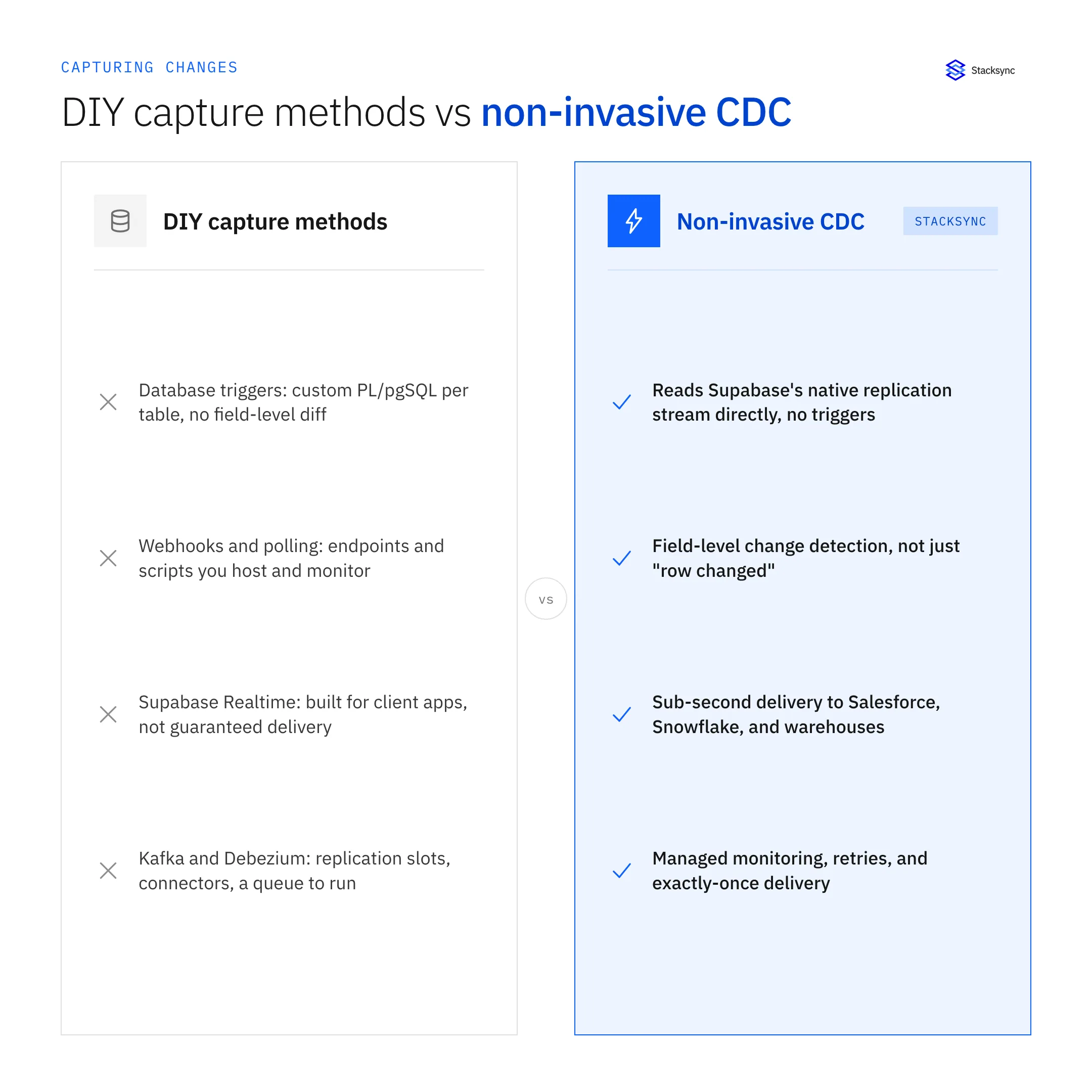
Non-invasive CDC for Supabase
A non-invasive approach means you can implement CDC without:
- Replication slot and plugin management
- PostgreSQL configuration changes
- Kafka clusters or connector fleets
- Webhook endpoints and polling scripts
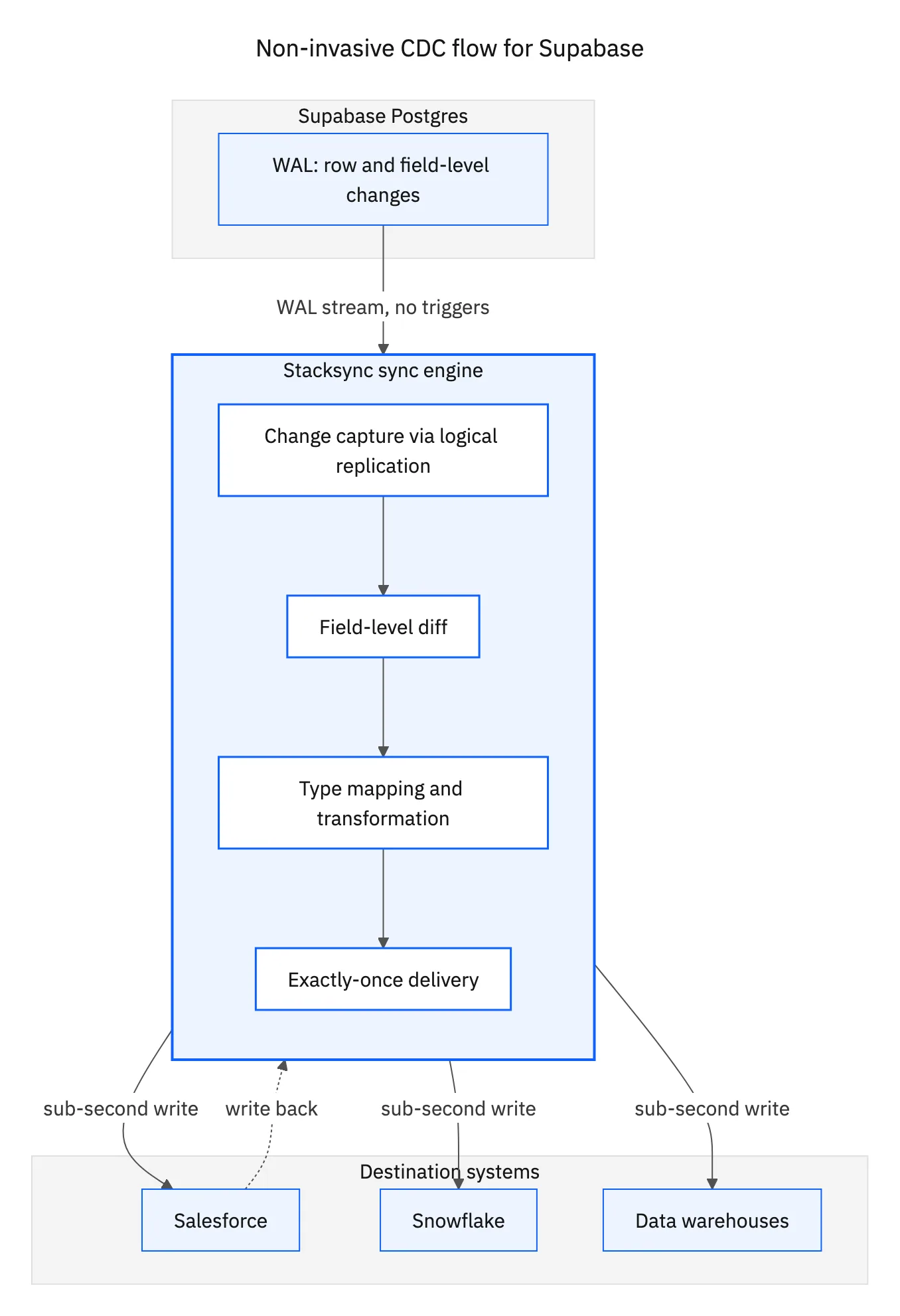
The goal is to treat CDC as managed infrastructure:
- Secure connectivity to Supabase via options like SSH tunnels or private networking
- Change capture using PostgreSQL-native mechanisms
- Type mapping and transformation to target systems
- Exactly-once delivery and replay
- Single-pane monitoring, alerting, and audit trails
Production Benchmarks to Sanity-check Your CDC Plan
Use these as practical targets for a production-grade Supabase CDC implementation:
- Initial snapshot: 1M rows in roughly 5 to 10 minutes with safe chunking
- Steady-state latency: p50 under 500ms, p99 under 2s
- Peak throughput: sustained tens of thousands of events per second
- Recovery time after outage: under 30 seconds with safe replay
Benchmarks are only meaningful when paired with observability and clear failure handling.
Failure Modes and How to Design for Recovery
Production CDC should answer these questions before go-live:
- What happens when the target system is down?
- How do retries avoid duplicate writes?
- How do you prevent partial failures from corrupting downstream data?
- How do you replay events safely after a recovery window?
- How do you detect and alert on lag before it becomes a business incident?
A strong CDC setup includes idempotent writes, durable replay, and deterministic conflict rules.
If your goal is real-time synchronization from Supabase to enterprise systems without Kafka, Debezium, and database modifications, the most practical path is using Supabase and Stacksync together.
Supabase provides the PostgreSQL backbone where your operational truth lives. Stacksync provides managed, non-invasive CDC and real-time bidirectional synchronization that streams changes from Supabase to systems like Salesforce and Snowflake with sub-second latency.
The value is simple:
- You keep the SQL-first developer experience you chose Supabase for
- You avoid building and operating a CDC platform
- You get monitoring, retries, replay, and auditability as infrastructure
For teams that need CDC to work like a utility, Supabase plus Stacksync turns CDC into a deployable capability rather than a six-month platform project.
CDC is the foundation of real-time operations, closed-loop analytics, and AI-ready enterprise data access. Supabase gives you strong PostgreSQL CDC primitives, but production-grade CDC requires reliability, observability, and delivery guarantees.
Implement CDC in a way that protects trust, not just throughput. When you need non-invasive CDC with sub-second sync to CRMs and warehouses, pairing Supabase with Stacksyncgives you an enterprise-grade path that preserves developer velocity and removes the infrastructure burden.

FAQ
Frequently asked questions








Related articles