

















Why MuleSoft Fails at Scale and How Stacksync Fixes It
Struggling with MuleSoft as you grow? See how Stacksync fixes performance bottlenecks, runaway API billing, and security sprawl with real-time sync.
- Author
- Ruben Burdin · Founder & CEO
- Published
- Updated
- Read time
- 10 min read

MuleSoft is a widely adopted Integration Platform as a Service (iPaaS) used by enterprises to connect applications and data through its API-led methodology. Its initial appeal lies in creating a network of reusable services, which can be effective for certain integration patterns.
However, as organizations scale, data volumes explode, and the demand for real-time operational consistency becomes paramount, many face significant mulesoft integration challenges. The very architecture that makes MuleSoft a powerful API management tool can become a source of performance bottlenecks, soaring costs, and reliability issues.
For modern, data-driven businesses, these limitations are not just technical inconveniences; they are direct inhibitors of growth. This is where Stacksync, a modern platform built for high-volume, real-time data synchronization, offers a more scalable, efficient, and cost-effective alternative.
The Core Problem: MuleSoft's Integration Challenges at Scale
While MuleSoft is a capable tool for orchestrating services and managing APIs, its architecture presents fundamental problems for high-volume, real-time data synchronization. As businesses grow, the need for instantaneous data flow between critical systems like CRMs (Salesforce, HubSpot), ERPs (NetSuite, SAP), and operational databases becomes essential. This is where MuleSoft's API-led connectivity model often begins to show cracks, creating friction where there should be flow.
1. Architectural and Performance Bottlenecks
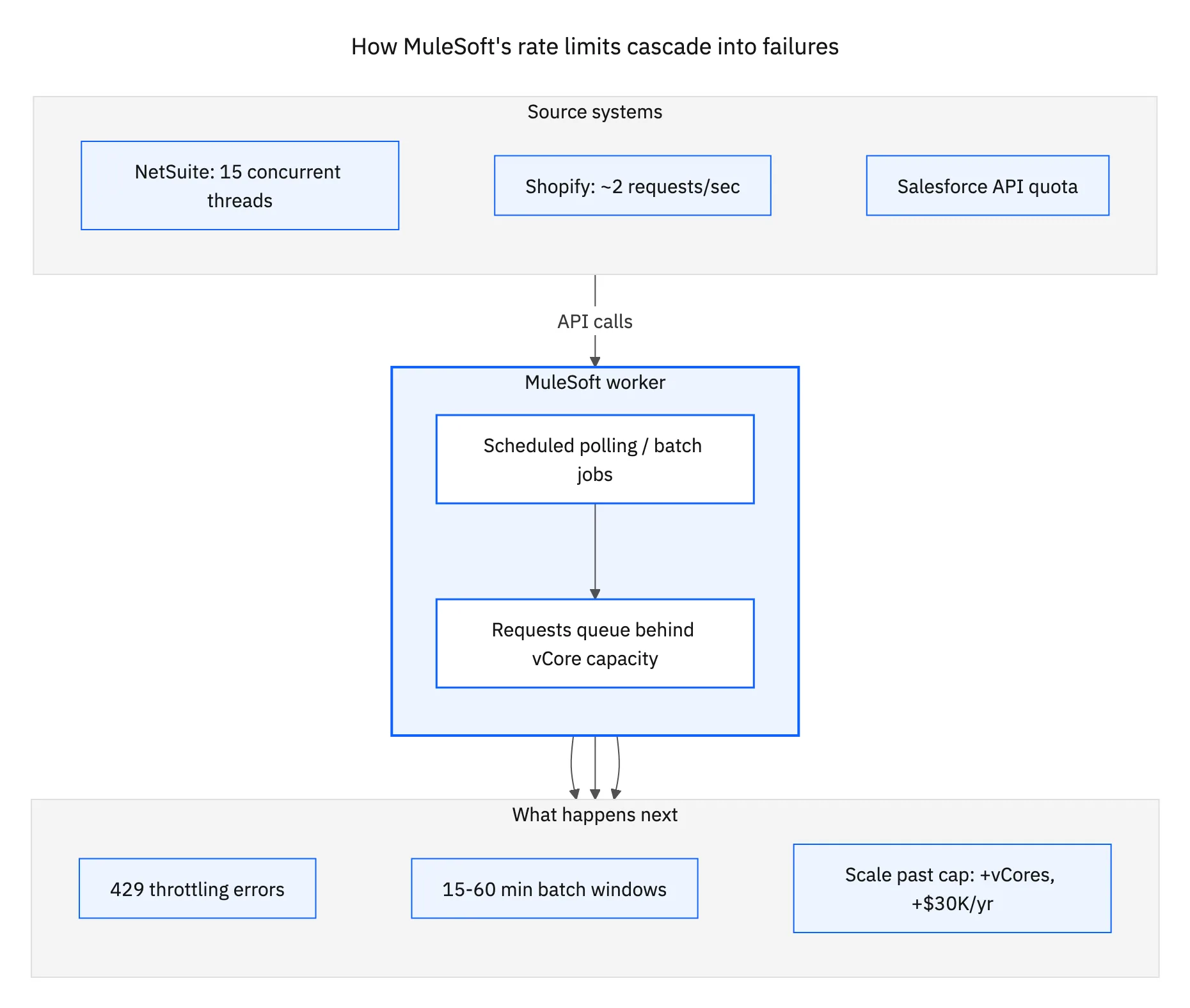
One of the most common mulesoft integration challenges is performance degradation under heavy loads. MuleSoft's architecture, which often relies on scheduled batch jobs or polling APIs, introduces latency that is unacceptable for mission-critical operational workflows. This leads to slow data transfers and delayed updates between systems.
Scaling a MuleSoft environment to meet rising demand is also notoriously complex. Both vertical scaling (adding more CPU/memory to a worker) and horizontal scaling (adding more workers) can be difficult and expensive to manage effectively [6]. Furthermore, MuleSoft’s own CloudHub imposes constraints on its workers, which can quickly become a bottleneck for large-scale deployments and drive up costs without a proportional increase in performance [1]. The platform has documented hard limits on deployments, servers, and properties, which can force complex and costly workarounds as an organization’s integration needs grow [7].
These architectural limits show up as hard API rate ceilings on the systems MuleSoft connects to. NetSuite Tier 1 accounts cap operations at 15 concurrent threads, triggering 429 errors the moment multiple workflows compete for the same pool; scaling past that requires SuiteCloud Plus licenses at roughly $12,000 per year for each additional 10 threads. Shopify enforces a leaky-bucket limit of about 2 requests per second on standard plans, with its GraphQL API capped at 1,000 cost points per minute. Database-backed integrations hit a similar wall: PostgreSQL instances degrade past roughly 100 concurrent connections, and MuleSoft deployments that spin up thousands of ephemeral connections during traffic spikes can crash the database itself. Workarounds like PgBouncer connection pooling or custom retry queues add operational overhead without removing the underlying constraint.
2. Soaring Costs and High Total Cost of Ownership (TCO)
MuleSoft's pricing model is notoriously complex, based on factors like vCores, connectors, and API calls that are difficult to predict and manage. As your data volume and integration needs grow, costs can spiral out of control, leading to a high Total Cost of Ownership (TCO). This financial burden is compounded by the fact that integration challenges are a leading cause of digital transformation failure, with the average cost of a single botched initiative reaching $9.5 million [4].
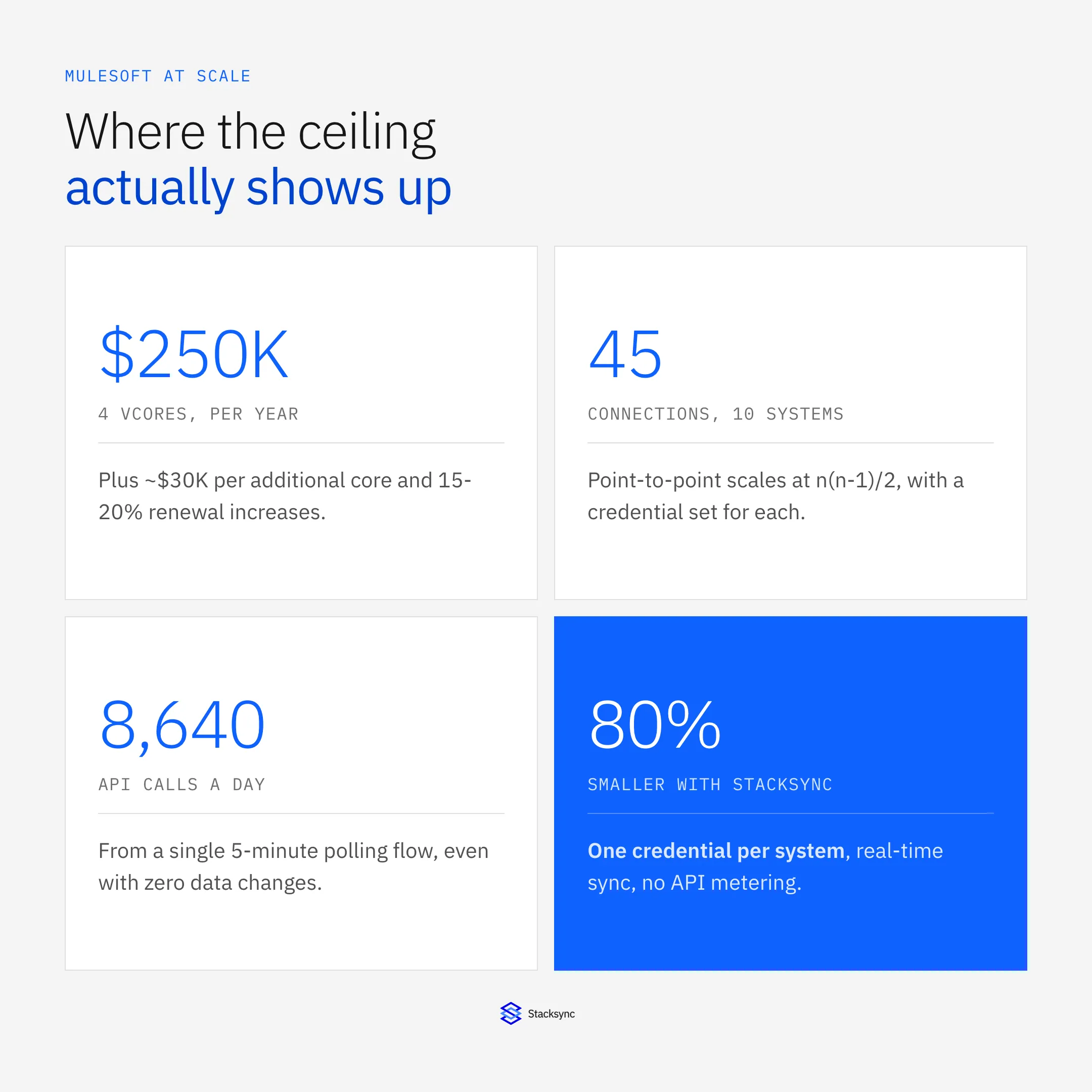
Concretely, organizations typically pay approximately $250,000 annually for four vCores, with each additional core costing around $30,000, and renewal negotiations frequently bring 15-20% annual price increases regardless of the value delivered. It amounts to a success tax: as a business grows and needs more integration capacity, MuleSoft's step-function pricing tiers financially penalize that growth. The same dynamic shows up in engineering time. Data teams typically spend 50-60% of their available hours maintaining existing MuleSoft pipelines rather than building new capability, with organizations reporting around 60 integration incidents a month at roughly 15 hours to resolve each, an estimated $500,000 a year in labor for a mid-sized team of five data engineers.
Beyond licensing, the platform demands a high level of specialized expertise. The scarcity of certified MuleSoft developers means organizations must invest heavily in hiring and retaining talent simply to build, maintain, and troubleshoot their integration flows. This diverts valuable engineering resources away from core product innovation. In contrast, modern platforms offer a more transparent and predictable pricing model.
3. Lack of True Real-Time, Bidirectional Sync
MuleSoft's core API-led methodology is excellent for creating reusable, discoverable APIs. However, it is fundamentally not optimized for true real-time, two-way data synchronization. Most MuleSoft integrations operate in a "near-real-time" or batch-processing mode, introducing delays that can range from seconds to many minutes.
This inherent latency creates significant business risks. Delayed or one-way data flows lead to data silos, inconsistencies between systems, and ultimately, unreliable business intelligence [2]. When sales, finance, and operations teams are working with conflicting data, decisions become flawed and opportunities are missed. A platform designed specifically for real-time integration power is required to solve this core issue.
4. Expanding API Attack Surface
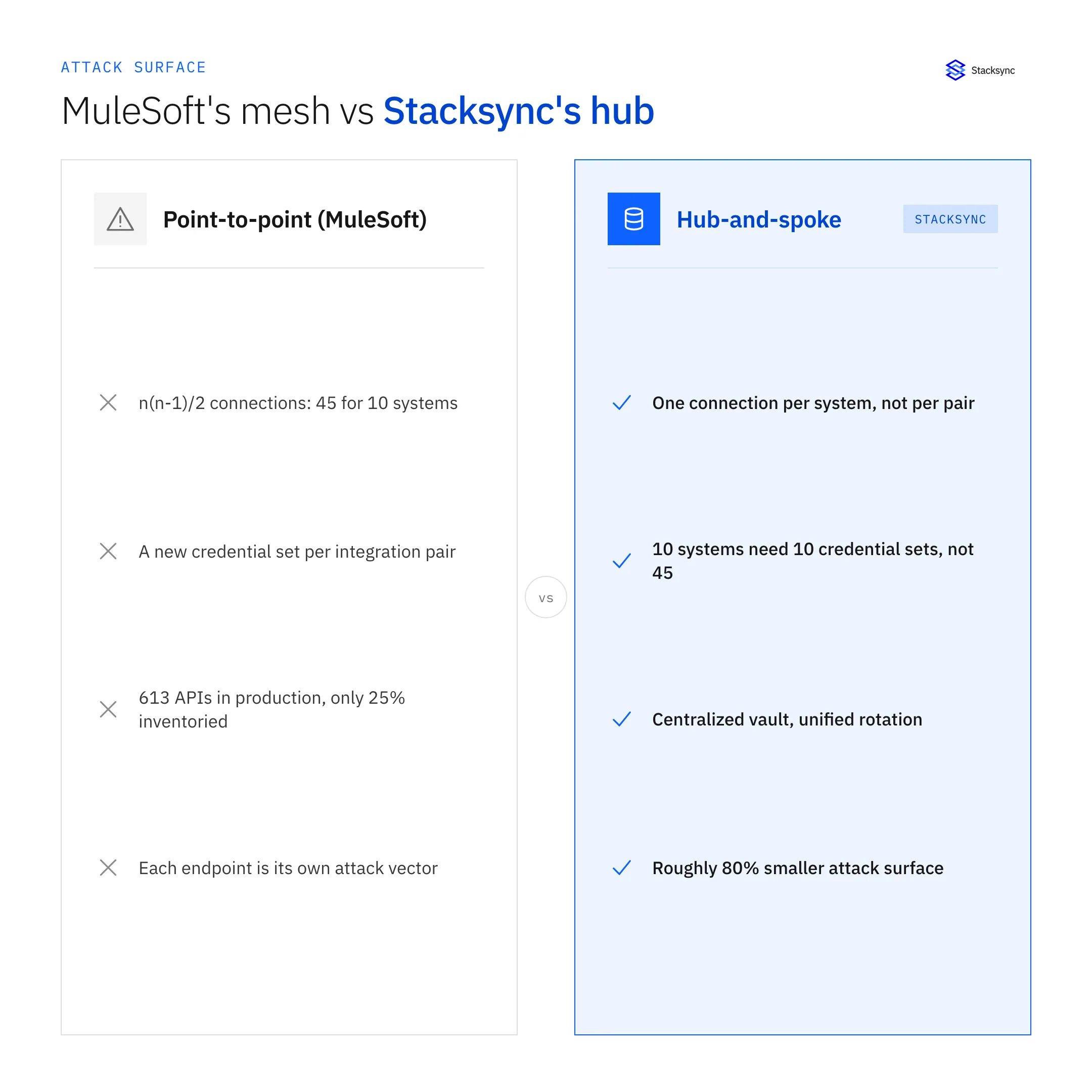
Scale compounds a fourth problem that is easy to miss until a security review surfaces it: MuleSoft's point-to-point model creates a new API connection, and a new set of credentials, for every system pair you integrate. Ten connected systems means 45 separate connections at n(n-1)/2 complexity, each with its own credentials, authentication method, and endpoint to patch and monitor. The average enterprise now runs 613 APIs in production with only 25% of them fully inventoried, and integration-related breaches average $4.88 million. Every MuleSoft flow you add to hit a scaling target also adds to that exposed surface.
How Stacksync Solves MuleSoft's Scalability Problems
Stacksync is a modern data sync and workflow automation platform engineered specifically to overcome the scalability, performance, and cost challenges that legacy iPaaS solutions like MuleSoft fail to address. It provides a fundamentally different approach focused on operational data integrity as data volumes grow.
Built for True Real-Time, Two-Way Synchronization
Stacksync is built from the ground up for real-time, bidirectional data synchronization, moving data between systems in milliseconds, not minutes. This is not "near-real-time"; it is an event-driven architecture that ensures data consistency is maintained instantly across your entire technology stack.
- Real-Time Speed: Our platform powers mission-critical use cases that cannot tolerate delays, such as real-time inventory updates, immediate customer data propagation, and instant financial calculations.
- Two-Way Sync: Stacksync ensures data consistency across all connected systems automatically with built-in conflict resolution, eliminating the need for complex, brittle custom logic.
- Triggers: You can build powerful, custom workflows that run instantly whenever records are created, updated, or deleted in any connected system.
This architecture is why Stacksync outperforms Workato, MuleSoft, Fivetran, and Heroku Connect for operational data synchronization.
Automatic Scalability and Predictable Performance
Stacksync's modern, cloud-native architecture is designed to scale with your business from day one. You can move from syncing thousands to millions of records without ever having to manage infrastructure, configure vCores, or worry about performance degradation.
- Scale to millions of records: Handle massive data volumes confidently. Our platform is benchmarked to process millions of records without manual intervention.
- Smart API Rate Limits: We automatically manage API quotas across your connected systems, using techniques like dynamic API switching and payload optimization to prevent hitting rate limits and causing failures.
- No-Code/Pro-Code Flexibility: Give business users a simple, no-code interface while providing engineers with powerful tools like Configuration as Code (CaC) for version control and governance as you grow.
Explore our Data Sync & Workflow Automation Platform to see how we remove the complexity of scaling.
Superior Reliability and Developer Experience
One of the biggest pain points with traditional integration tools is the prevalence of "silent sync failures" that corrupt data without warning (see our guide on detecting silent failures in MuleSoft API flows for how these show up before you switch). Stacksync was designed to provide unparalleled reliability and visibility.
- Issue Management Dashboard: Get full visibility into sync status. Retry, revert, or investigate any sync issue with a single click, preventing data corruption before it happens.
- Advanced Logging & Monitoring: Use our powerful log explorer to monitor data flows in detail and troubleshoot issues in real-time, giving your team complete control.
- Replay Failed Workflows: Quickly debug and replay entire workflows or specific failed modules to resolve issues without impacting data integrity.
A Smaller, Safer Attack Surface
Because Stacksync connects each system once instead of once per integration pair, ten connected systems need ten credential sets instead of MuleSoft's 45. Security teams manage rotation, access policy, and audit logging from one place instead of dozens of workflow configurations, cutting credential exposure by roughly 80%. Data access policies apply at the database layer (row-level security, column encryption, role-based permissions) instead of being hand-built into each flow, and Stacksync maintains SOC 2 Type II, GDPR, HIPAA BAA, ISO 27001, and CCPA compliance so you inherit that posture instead of building it yourself.
Billed for Records, Not API Calls
A MuleSoft flow polling Salesforce every 5 minutes generates 8,640 API calls a day even when nothing changed, and that consumption is what shows up on the invoice. Teams try to claw costs back with caching, batching, and Change Data Capture, each shaving 40-90% off a specific workflow's call volume, but the billing model itself still meters every request. Stacksync replicates through change data capture at the database layer, so API consumption never enters the pricing equation at all; organizations moving off API-metered MuleSoft billing report savings exceeding $30,000 a year.
Stacksync vs. MuleSoft: A Head-to-Head Comparison
A direct comparison clearly illustrates the advantages of Stacksync for modern, scalable data integration.
| Feature | MuleSoft | Stacksync |
|---|---|---|
| Scalability | Complex (vCore-based, manual tuning) | Automatic (built-in, auto-scaling) |
| Sync Speed & Type | API-led (batch / near-real-time) | Real-Time & Two-Way (milliseconds) |
| Pricing Model | Complex & Opaque (licenses, connectors) | Transparent (based on synced records) |
| API Billing | Pay per API call (polling adds up fast) | No API metering (record-based pricing) |
| Attack Surface | n(n-1)/2 connections, per-flow credentials | 1 credential per system (~80% smaller) |
| Ease of Use | High (requires certified developers) | Low (no-code & pro-code) |
| Issue Management | Basic (requires custom logic) | Advanced (built-in dashboard) |
| Total Cost of Ownership (TCO) | High | Low & Predictable |
Key Takeaways
Stacksync delivers real-time, bi-directional synchronization with auto-scaling, transparent pricing, and no-code simplicity, all within a single managed platform.
MuleSoft offers capable API-led integration but comes with high setup complexity, ongoing maintenance, and costly licensing tied to vCores and connectors.
For organizations seeking speed, simplicity, and lower TCO, Stacksync provides a faster and more predictable alternative to traditional enterprise iPaaS platforms.

Conclusion: Stop Patching, Start Syncing
While MuleSoft served a purpose in the era of service orchestration, its architecture is fundamentally unsuited for the demands of modern, data-driven enterprises. Companies that require scalable, reliable, and real-time integration are finding that patching together MuleSoft flows is no longer a viable strategy.
Stacksync offers a clear path forward. By providing a platform built for real-time, bidirectional sync, we help organizations remove data silos, reduce engineering overhead, and improve operational efficiency. It's time to move beyond the limitations of legacy iPaaS. Book a demo to see how Stacksync can solve your integration challenges.

FAQ
Frequently asked questions










Related articles