


















The Hidden Costs of Delayed Data Synchronization: How Real-Time Integration Impacts Your Bottom Line
Delayed data synchronization has a real cost: lost revenue, manual rework, and slower decisions. See the numbers and how real-time sync fixes it.
- Author
- Ruben Burdin · Founder & CEO
- Published
- Updated
- Read time
- 8 min read

Many organizations still run on disconnected systems and delayed data synchronization, and most underestimate the true financial impact of that lag. The direct cost of an integration platform is easy to measure. The hidden cost of delayed data synchronization is not, and it is usually larger: it quietly erodes profitability, slows growth, and chips away at competitive advantage.
The True Price Tag of Data Delays
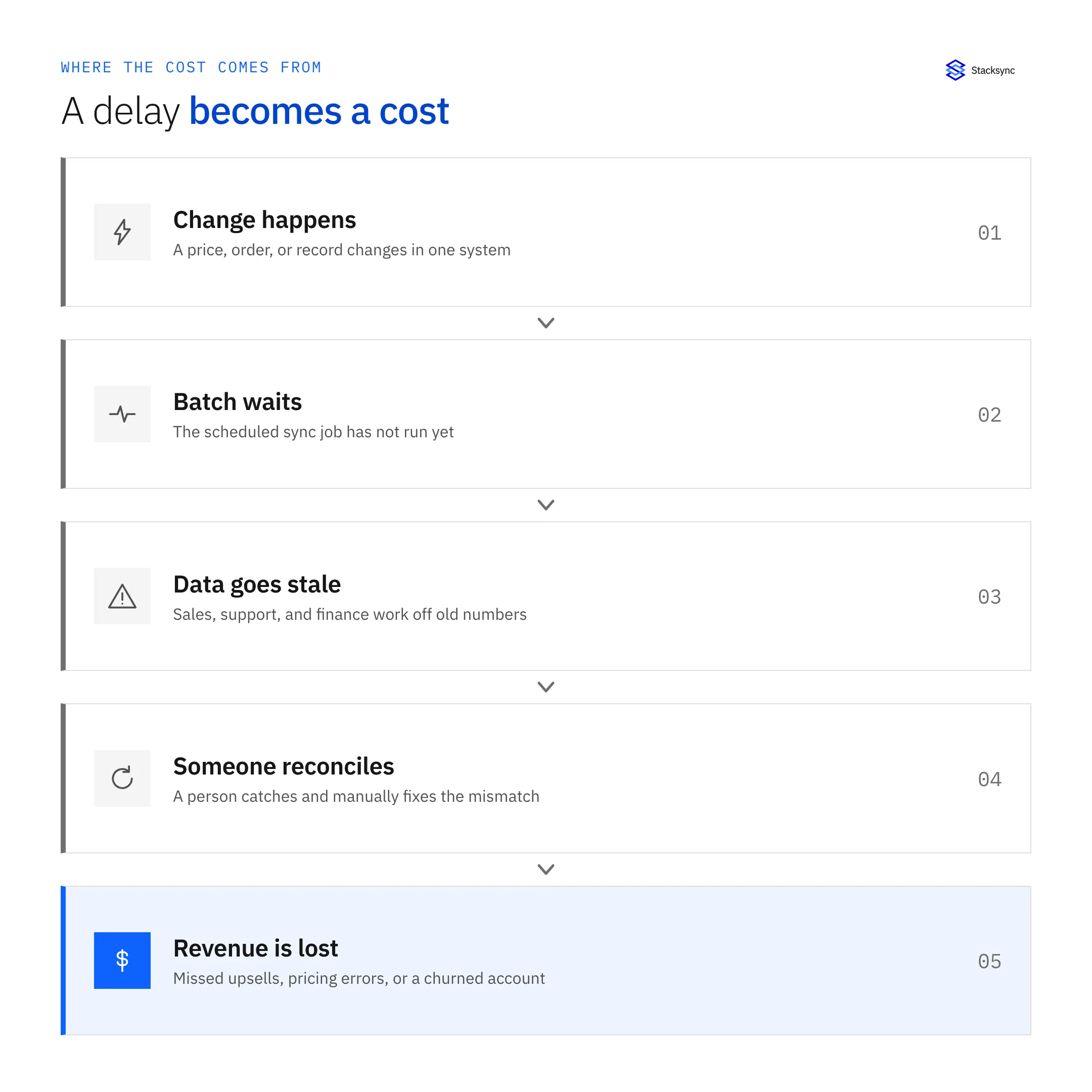
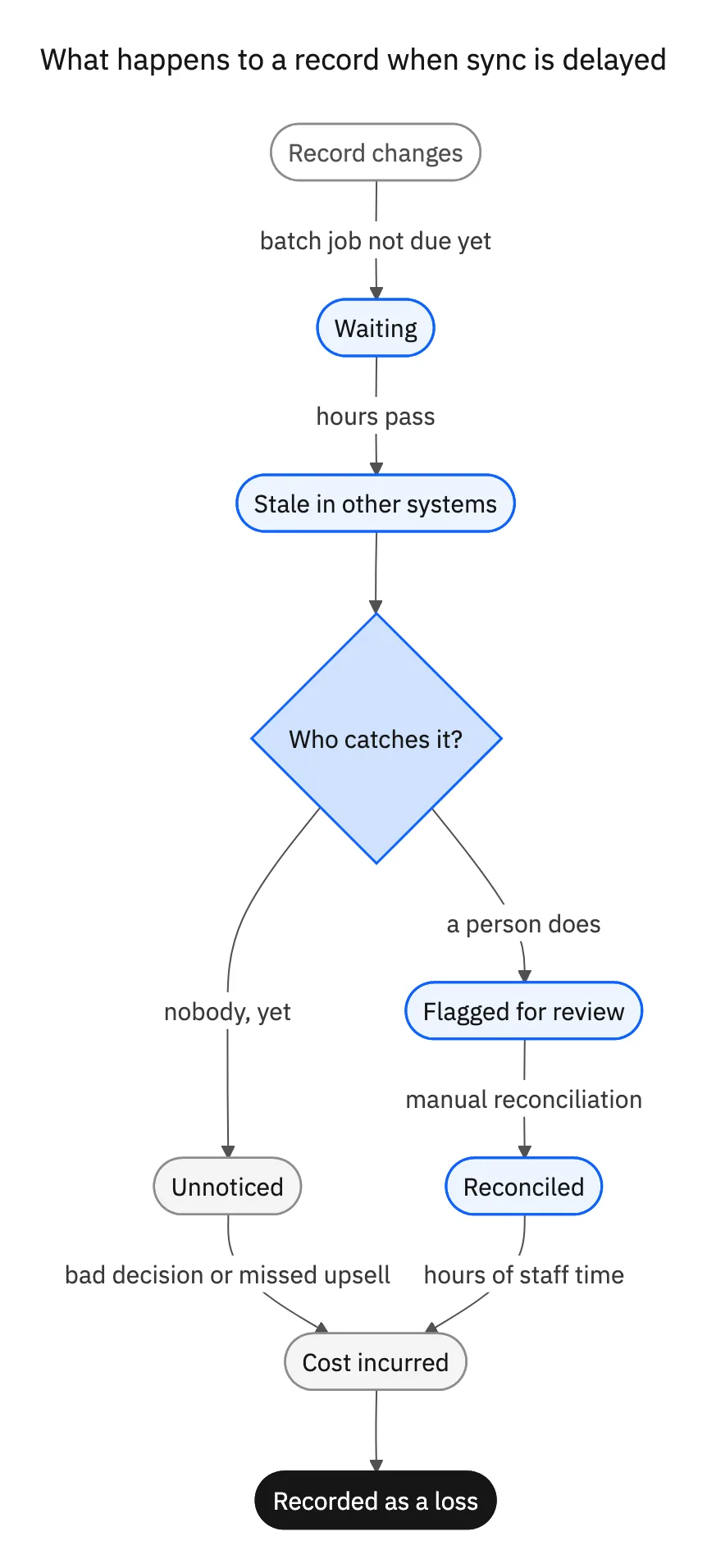
When customer, product, and operational data isn't synchronized in real time across systems, the consequences extend far beyond minor inconveniences. These hidden costs accumulate across multiple dimensions of your business:
1. Revenue Leakage
Delayed data synchronization creates significant revenue leakage that directly impacts your bottom line:
- Missed Upsell Opportunities: When sales teams lack real-time visibility into customer activity or product usage, they miss critical moments to upsell or cross-sell. According to a 2024 industry study, companies with real-time data synchronization between CRM and product systems capture 23% more upsell revenue than those with batch-based processes.
- Pricing Inconsistencies: When product and pricing data isn't synchronized in real time between systems, organizations frequently sell at outdated or incorrect prices. For a mid-market business, this inconsistency can result in 2-5% revenue leakage annually.
- Extended Sales Cycles: Without real-time access to customer information, sales cycles extend unnecessarily. Research shows that real-time integration between CRM and operational systems reduces sales cycle length by an average of 28%, directly impacting revenue velocity.
2. Operational Inefficiency
Delayed synchronization creates expensive operational friction that compounds over time:
- Manual Data Reconciliation: Without real-time integration, staff must manually reconcile data between systems. A typical mid-market company dedicates 15-20 hours per week to manual data reconciliation tasks, the equivalent of 0.5 FTE annually, or approximately $45,000 in salary costs alone.
- Error Correction and Rework: When working with outdated information, errors multiply. Organizations report spending 30-40% of project time correcting issues that stem from data inconsistencies, time that could be directed toward growth initiatives.
- Workforce Productivity Drain: Employees waiting for data updates or manually transferring information between systems represents a massive productivity drain. Companies with real-time integration report 37% higher employee productivity in data-dependent roles.
3. Customer Experience Degradation
Perhaps the most costly impact of delayed synchronization is on customer experience:
- Support Inefficiency: When customer support lacks real-time visibility into customer status, orders, or activity, resolution times increase by 43% on average. This not only increases support costs but damages customer satisfaction.
- Order and Delivery Delays: Without real-time integration between sales and operational systems, order processing delays occur regularly. Studies show that companies with real-time integration between CRM and ERP systems reduce order fulfillment time by 67%.
- Customer Churn: The cumulative effect of these experience issues leads to increased customer churn. Research indicates that businesses with fragmented customer data experience churn rates 36% higher than those maintaining consistent, synchronized customer information across touchpoints.
4. Strategic Opportunity Costs
Beyond direct costs, delayed synchronization imposes significant strategic opportunity costs:
- Delayed Market Response: Organizations that can't rapidly analyze cross-system data miss market trends and competitive threats. Companies with real-time data integration respond to market changes 2.7x faster than those without.
- Innovation Constraints: When engineering resources are tied up maintaining legacy integrations (up to 30-50% of engineering time in mid-market companies), innovation suffers. This is perhaps the largest hidden cost: initiatives that never get pursued because of resource constraints.
- Decision Paralysis: Without trusted, real-time data, decision-making defaults to gut feeling or delays until more information is gathered. This paralysis costs organizations an estimated 5-7% in foregone opportunities annually.
Case Study: The Financial Impact of Real-Time Integration
To illustrate these costs, consider the experience of a mid-market logistics company that implemented real-time, bi-directional synchronization between Salesforce, their operational database, and NetSuite:
Before Real-Time Integration:
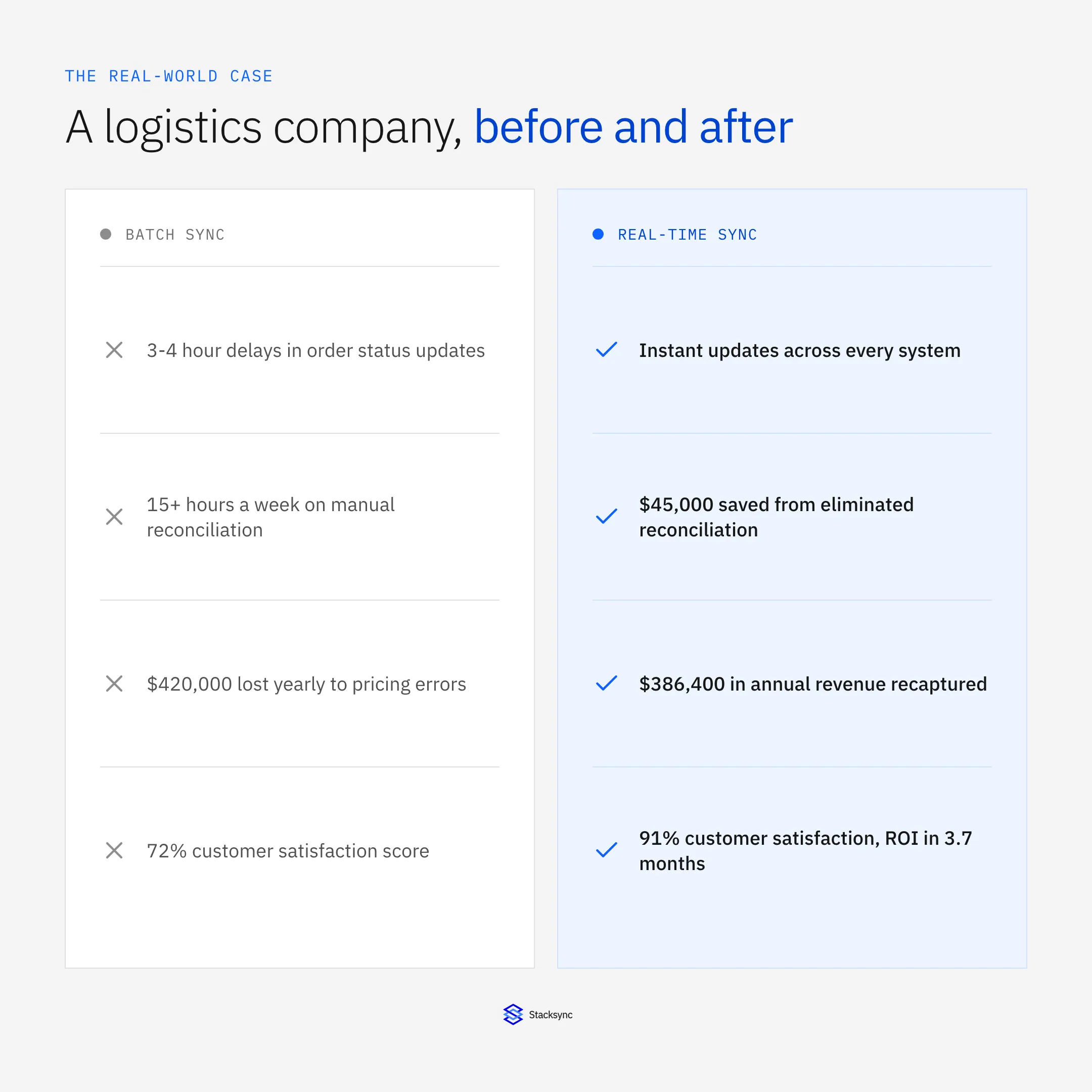
- 3-4 hour delays in order status updates
- 15+ hours weekly spent on manual data reconciliation
- $420,000 annual revenue loss from pricing discrepancies
- 23% error rate in customer deliveries due to data inconsistencies
- Customer satisfaction scores of 72%
After Real-Time Integration:
- Instantaneous data updates across all systems
- Manual reconciliation eliminated, saving $45,000 annually
- Pricing discrepancies reduced by 92%, recapturing $386,400 in annual revenue
- Delivery error rate decreased to 3.5%
- Customer satisfaction increased to 91%
The company achieved complete ROI on their integration investment in just 3.7 months, with ongoing annual benefits of $580,000+ in direct cost savings and recaptured revenue.
The Engineering Resource Drain
One often overlooked cost of delayed data synchronization is the massive engineering resource drain. According to industry research, engineers in mid-market companies often spend 30-50% of their time maintaining integrations rather than building core product features.
This "integration tax" is not just a direct cost. It's an opportunity cost: think about what your engineering team could be building instead of maintaining fragile data pipelines.
As the CEO of Stacksync notes, "Engineers spend countless hours manually transforming data for CRM integrations or pay large amounts to consulting firms to do the same. Dynamic schemas from different clients or apps require engineers to build and maintain custom integration pipelines one by one, and companies spend days, weeks, and even months building integrations."
The financial calculus becomes clear when you consider:
- Average fully-loaded cost of a senior engineer: $180,000-$250,000 annually
- Percentage of time spent on integration maintenance: 30-50%
- Annual cost per engineer: $54,000-$125,000 dedicated to "integration plumbing"
For a team of just 5 engineers, this represents $270,000-$625,000 in annual engineering salary allocated to integration maintenance rather than innovation.
The Technology Gap: Batch vs. Real-Time
The fundamental challenge is that many organizations still rely on batch-based or scheduled synchronization approaches in an era where business happens in real-time:
| Synchronization Approach | Data Freshness | Business Impact |
|---|---|---|
| Manual Import/Export | Hours to days | Significant operational delays, high error rates |
| Scheduled Batch Sync | Hours | Moderate delays, daily reconciliation needed |
| Near Real-Time | Minutes | Minimal operational impact, occasional discrepancies |
| True Real-Time | Seconds | Continuous operational synchronization, minimal errors |
| Bi-Directional Real-Time | Instantaneous | Complete data consistency across all systems |
The technology gap between batch and real-time approaches translates directly to financial performance. Companies with real-time, bi-directional synchronization between operational systems report:
- 18-23% higher revenue growth
- 31% lower operational costs
- 42% higher customer satisfaction scores
- 37% faster time-to-market for new products and services
Building the Business Case for Real-Time Integration
To quantify the financial impact of real-time integration for your organization, consider these key metrics:
1. Direct Cost Savings
- Manual data handling hours: Track hours spent on manual data entry, exports/imports, and reconciliation
- Error correction costs: Measure time and resources dedicated to fixing data-related errors
- Support ticket reduction: Quantify decreases in data-related support tickets and resolution time
- Engineering time reallocation: Calculate engineering hours freed from integration maintenance
2. Revenue Impact
- Sales cycle acceleration: Measure decrease in days to close and increase in win rates
- Pricing accuracy improvement: Track reduction in pricing errors and discrepancies
- Upsell/cross-sell lift: Measure increase in additional product sales from timely data
- Customer retention improvement: Calculate reduction in churn due to improved service
A Framework for ROI Calculation
A simple framework for calculating ROI includes:
Annual Cost Savings:
- Reduction in manual data handling: $______
- Decrease in error correction costs: $______
- Support efficiency improvements: $______
- Engineering resource reallocation: $______
Annual Revenue Impact:
- Additional revenue from faster sales cycles: $______
- Recaptured revenue from pricing accuracy: $______
- Incremental upsell/cross-sell revenue: $______
- Improved retention value: $______
Integration Investment:
- Integration platform costs: $______
- Implementation and training: $______
- Ongoing management: $______
ROI Calculation:
- Total Annual Benefit (savings + revenue): $______
- Total Investment: $______
- Annual ROI: ______%
- Payback Period: ______ months

The Modern Approach: Real-Time, Bi-Directional Synchronization
Traditional integration approaches, whether manual processes, batch ETL, or even one-way real-time feeds fail to address the fundamental need for consistent, up-to-date data across all business systems.
Modern integration platforms like Stacksync offer a fundamentally different approach, providing "real-time and bidirectional data synchronization between CRMs (e.g. Salesforce, Hubspot) and databases (e.g. Postgres, BigQuery)." With this approach, "edits made in the CRM will instantly update in the Database, and vice-versa."
The key advantages of this modern approach include:
- Elimination of data lag: Changes propagate instantly across all connected systems
- Bi-directional updates: Data flows both ways, ensuring all systems remain in sync
- No-code implementation: Integration setup takes minutes instead of months
- Reduced engineering burden: No more custom code maintenance or integration firefighting
- Error and conflict handling: Sophisticated handling of concurrent updates and conflict resolution
Moving Forward: Key Recommendations
To address the hidden costs of delayed data synchronization in your organization:
- 01Audit Your Current State: Document your current integration approaches, synchronization frequency, and their business impact. Identify the most critical data flows for real-time synchronization.
- 02Quantify Hidden Costs: Use the framework provided to calculate the current costs of delayed synchronization across revenue, operations, customer experience, and strategic dimensions.
- 03Evaluate Modern Approaches: Assess real-time, bi-directional synchronization platforms that can eliminate integration complexity while delivering consistent data across systems.
- 04Start with High-Value Use Cases: Focus initial implementation on the integrations with the highest business impact, such as CRM-to-ERP synchronization or customer data unification.
- 05Measure and Iterate: Implement clear metrics to track the business impact of real-time integration, and expand to additional systems based on proven ROI.
Conclusion: From Cost Center to Strategic Advantage
Data synchronization is usually treated as a technical necessity, a cost center rather than a source of advantage. That view misses how much real-time integration changes day-to-day operations.
Organizations that implement real-time, bi-directional synchronization across their core systems don't just cut costs. They build a foundation for agility, faster shipping, and a better customer experience that shows up directly in the numbers.
The companies that come out ahead are the ones that treat the hidden costs of delayed data synchronization as real costs, and fix them with real-time integration, not the ones that keep budgeting around the problem.

FAQ
Frequently asked questions










Related articles