

















EDI Integration with NetSuite for Wholesale Distributors
Learn how EDI integration with NetSuite helps wholesale distributors reduce chargebacks, automate orders, and improve inventory accuracy in real time.
- Author
- Ruben Burdin · Founder & CEO
- Published
- Updated
- Read time
- 6 min read

What Is EDI Integration with NetSuite?
EDI integration with NetSuite connects wholesale distributors to retailers, suppliers, and logistics partners through automated electronic data interchange directly synchronized with NetSuite ERP. It enables direct exchange of purchase orders, invoices, advance shipment notices, and inventory updates without manual data entry.
For wholesale distributors operating on tight margins and high transaction volumes, EDI integration with NetSuite is essential for accuracy, compliance, and scalability.
Why Wholesale Distributors Depend on NetSuite + EDI
Wholesale distribution businesses manage thousands of SKUs, fluctuating inventory levels, and strict retailer compliance standards. NetSuite serves as the operational backbone for financials, inventory, order management, and fulfillment.
When EDI operates outside NetSuite or relies on batch processing, distributors face:
- Manual order re-entry into ERP
- Inventory mismatches across channels
- Delayed invoice generation
- Chargebacks from retail partners
- Inconsistent shipment confirmations
Direct EDI integration ensures that transactions flow automatically into NetSuite in real time.
Core EDI Transactions for Wholesale Distribution
Most distributors exchange standardized EDI documents with retail and supplier networks.
- EDI 850 Purchase Order
- EDI 855 Purchase Order Acknowledgment
- EDI 856 Advance Ship Notice
- EDI 810 Invoice
- EDI 846 Inventory Inquiry and Advice
- EDI 997 Functional Acknowledgment
Accurate mapping of these documents into NetSuite transaction records determines fulfillment speed and billing precision.
How Stacksync Delivers Real-Time NetSuite EDI Integration
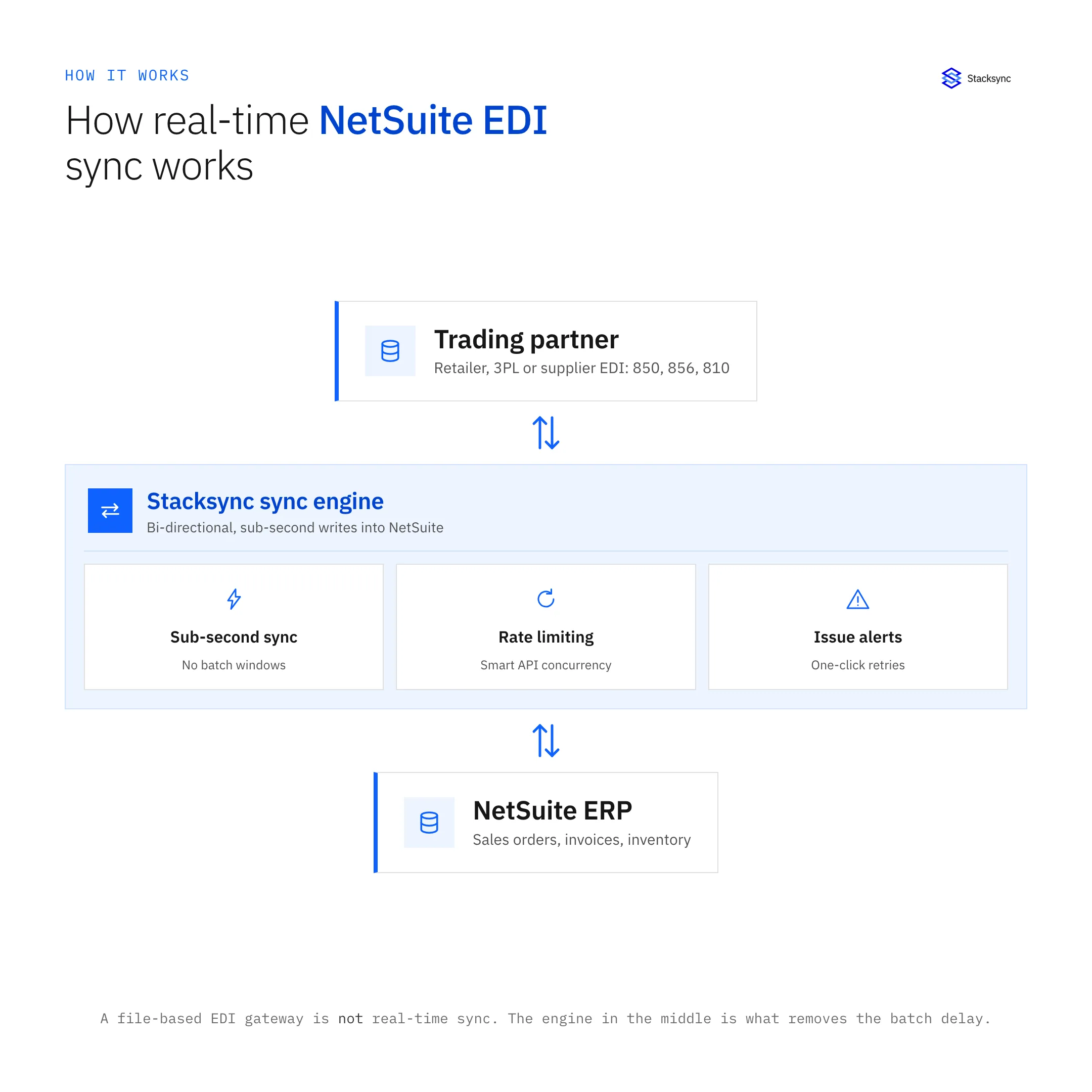
Stacksync connects your EDI translator or VAN directly to NetSuite through a no-code, bi-directional sync engine, replacing the batch windows and custom scripts that most EDI-to-ERP setups still rely on.
- Sub-second sync: Purchase orders (EDI 850), invoices (EDI 810), and inventory advices (EDI 846) write into NetSuite the moment they arrive, instead of on the next batch cycle.
- Smart API rate limiting: Stacksync automatically manages NetSuite API concurrency so high transaction volumes do not throttle or drop records during peak retail periods.
- Issue management dashboard: Failed or rejected transactions surface with proactive alerts and one-click retries, instead of silent failures discovered days later.
- Enterprise-grade security: SOC 2, GDPR, and ISO 27001 compliant, which matters when trading partner data flows through the pipeline.
Distributors connect NetSuite through the NetSuite two-way sync connector and route EDI documents through Stacksync's EDI integration use case, without months of custom middleware development.
Operational Risks of Poor NetSuite EDI Integration
1. Inventory Inaccuracy
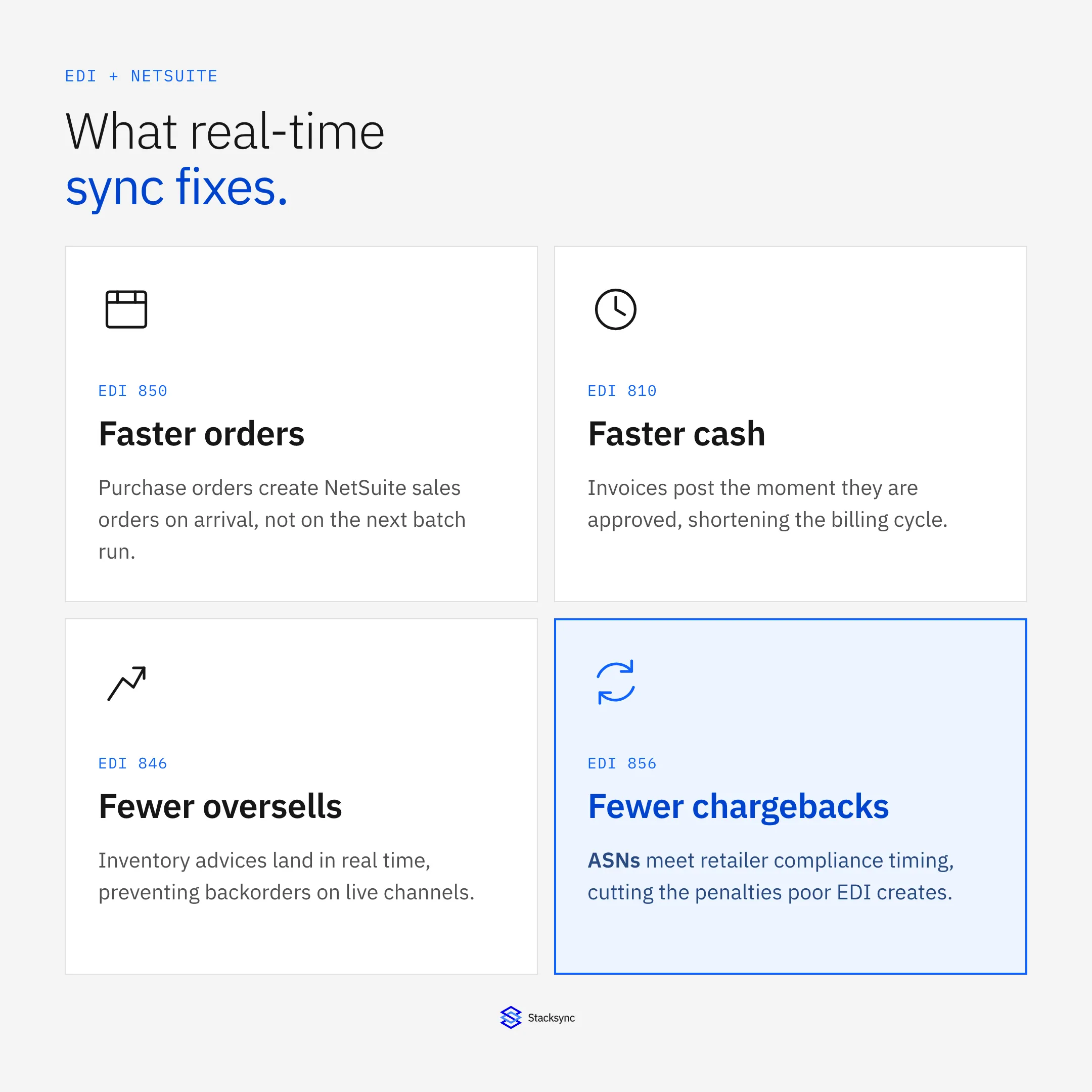
If EDI 846 inventory updates are delayed, retailers may oversell products, leading to backorders and lost trust.
2. Revenue Recognition Delays
Invoices that require manual validation before posting in NetSuite delay revenue booking and extend cash cycles.
3. Compliance Penalties
Retailers impose strict ASN timing requirements. Late or rejected EDI 856 transmissions trigger financial penalties.
4. Increased Labor Costs
Manual reconciliation between EDI systems and NetSuite consumes finance and operations resources.
Batch vs Real-Time NetSuite EDI Integration
| Integration Model | Sync Speed | Inventory Accuracy | Financial Impact |
|---|---|---|---|
| Manual + Batch EDI | 15–60 minute delays between updates | Frequent discrepancies and reconciliation gaps | High chargeback risk and margin erosion |
| One-Way Sync | Partial visibility with delayed reverse updates | Limited system alignment across tools | Medium financial and compliance risk |
| Real-Time Bi-Directional Sync | Sub-second updates across connected systems | Accurate inventory and order data in real time | Reduced penalties and faster, more predictable billing |
Key Takeaways
Manual and batch EDI models create latency that drives inventory mismatches and increases exposure to costly chargebacks.
One-way synchronization improves automation but still leaves blind spots that affect system alignment and financial predictability.
Real-time bi-directional sync ensures continuous data consistency, protects margins, and accelerates billing cycles.
For high-volume distributors, even small latency windows create compounding operational risk.
Architecture Best Practices for NetSuite EDI Integration
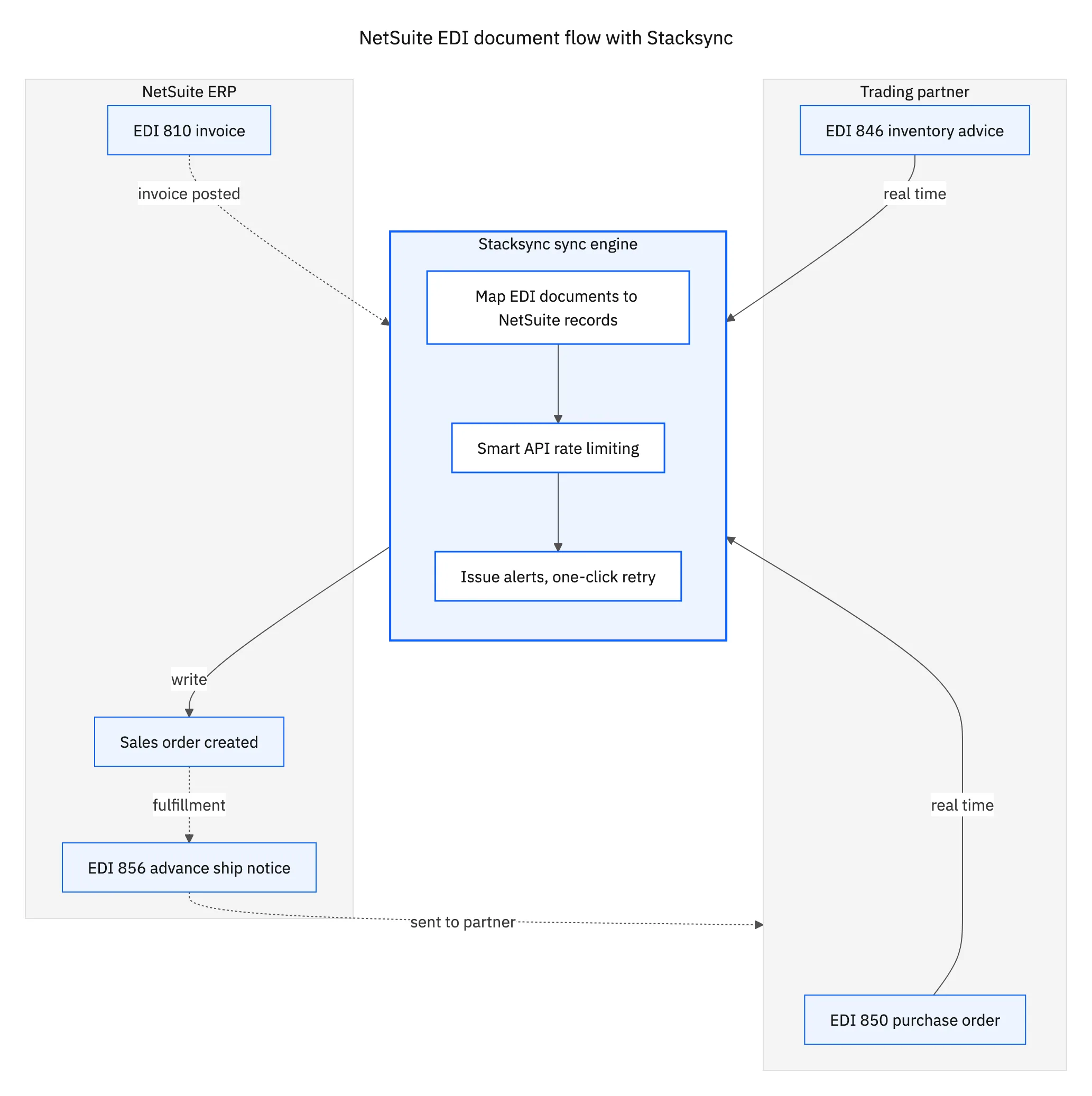
Modern wholesale distributors are moving beyond file-based EDI gateways toward real-time integration layers that connect directly to NetSuite records.
Best practices include:
- Mapping EDI documents directly to NetSuite transaction types
- Automating validation rules before record creation
- Enabling bi-directional synchronization between NetSuite and operational databases
- Implementing exception-based alerts instead of manual review queues
- Monitoring API rate limits to prevent throttling issues
This architecture ensures that purchase orders, shipments, and invoices are processed continuously rather than in batch windows. High EDI volume shares the same root cause as most NetSuite integration slowdowns: see how to fix NetSuite API rate limit errors for the underlying concurrency mechanics.
Benefits of Modern EDI Integration with NetSuite
Faster Order Processing
Automatic creation of sales orders from EDI 850 documents reduces manual entry and accelerates fulfillment.
Improved Cash Flow
Real-time invoice generation from EDI 810 documents shortens billing cycles and reduces disputes.
Reduced Chargebacks
Continuous synchronization ensures ASNs meet retailer compliance timing standards.
Scalable Retail Onboarding
Pre-built EDI connectors allow distributors to onboard new trading partners in days instead of months.
Better Forecasting Accuracy
Real-time inventory and order data improve demand planning and financial forecasting.

Implementation Considerations for Distributors
Before modernizing EDI integration with NetSuite, wholesale distributors should evaluate:
- Daily transaction volume
- Number of retail trading partners
- Custom NetSuite record types and workflows
- Compliance requirements by retailer
- API concurrency and rate limits
- Required bi-directional synchronization flows
The objective is not only connectivity but synchronized operational precision across finance, fulfillment, and partner systems.
Apply this in commercial flooring and interior installation: purchase line and product conversion
Flooring suppliers and installation contractors exchange the same purchase-order, shipment, and invoice documents with an additional unit challenge: rolls, boxes, pieces, and pallets must remain consistent. Apply the EDI mapping to the approved product and quantity definitions for the actual delivery.
| Record to reconcile | Responsible owner | Rule to preserve |
|---|---|---|
| Purchase line | Buyer | Store ordered unit, quantity, supplier item and project allocation. |
| Product conversion | Item administration or estimating | Maintain the reviewed relationship between package units and area. |
| Shipment packaging | Supplier and receiving | Preserve pallet, box or roll relationships where the partner provides them. |
An exception to plan for: Pallet contains mixed box counts. Read the supplied packaging detail and actual receipt; do not apply a blanket pallet conversion. Acceptance check for the pilot: every quantity carries an explicit unit.
The commercial flooring and interior installation hub connects the broader operating context. These guides develop the specific record mappings and decisions for this application:
Distribution Growth Depends on Integration Accuracy
Wholesale distribution margins depend on operational efficiency and compliance discipline. EDI errors and synchronization delays directly impact revenue, retailer relationships, and cash flow.
Distributors that implement real-time NetSuite EDI integration move from reactive reconciliation to proactive supply chain management. In competitive wholesale markets, integration precision becomes a strategic advantage. Distributors evaluating platforms beyond native EDI tooling can also compare options in the NetSuite Integration Platform (NSIP) alternatives guide.

FAQ
Frequently asked questions










Explore these integrations and topics
Related articles