Integration Complexity Scales Faster Than Business Systems
Integration complexity scales at n(n-1)/2 while business systems grow linearly. Learn why point-to-point connections fail and how modern platforms solve this.
- Author
- Ruben Burdin · Founder & CEO
- Published
- Updated
- Read time
- 7 min read
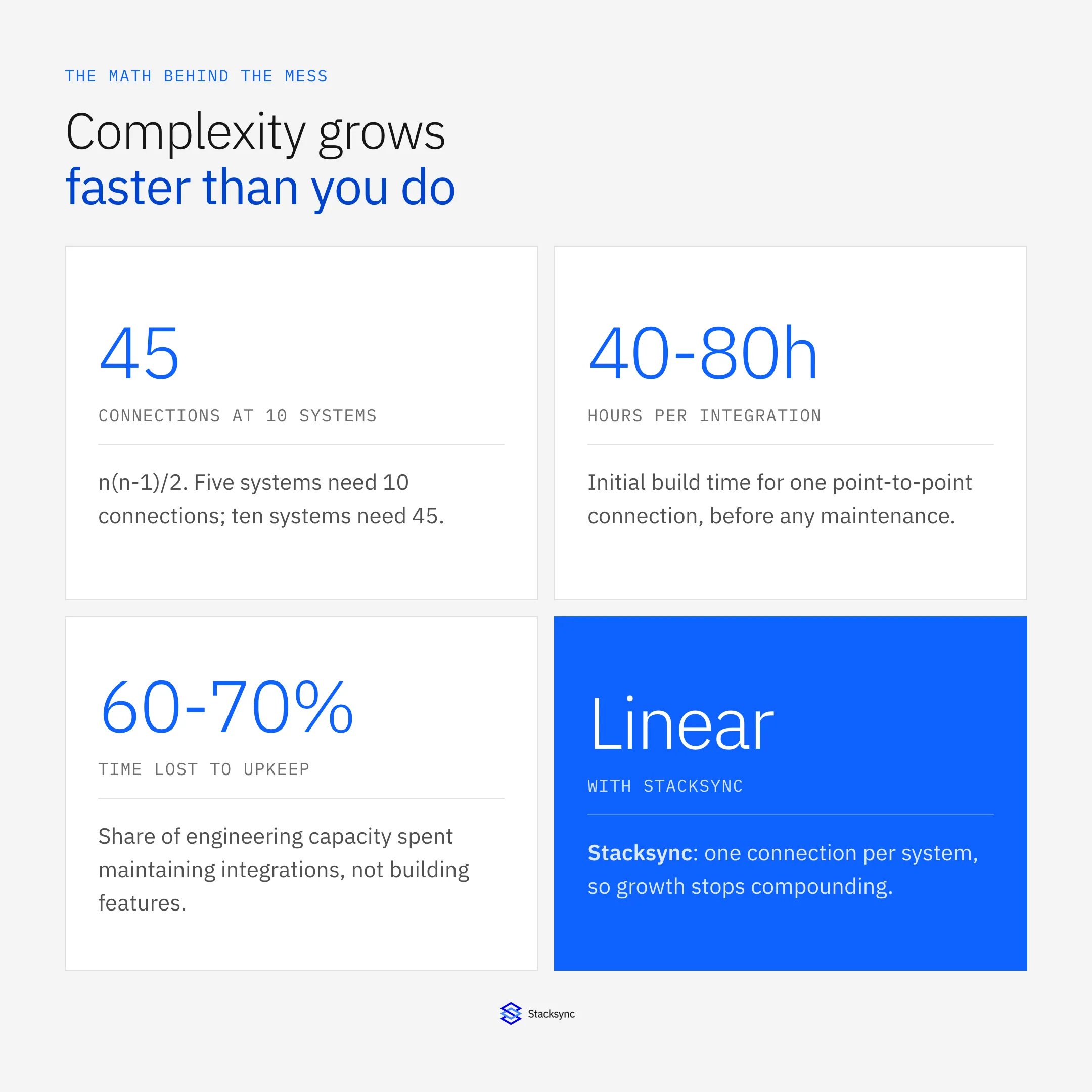
Integration complexity increases quadratically at n(n-1)/2 while business systems grow linearly, creating unsustainable technical debt as organizations scale. A company adding its fifth business system creates 10 integration connections, but the tenth system requires 45 connections. This exponential growth consumes engineering resources faster than business value creation, with organizations reporting 60-70% of development time maintaining integrations rather than building features. Database-centric platforms like Stacksync reduce complexity to linear growth by eliminating point-to-point connections.
The Mathematics of Integration Sprawl
Understanding why integration maintenance overwhelms engineering teams requires examining how connection requirements scale.
Point-to-Point Connection Growth
Traditional integration architectures connect each system directly to every other system requiring data exchange. The mathematical relationship follows combinatorial growth patterns.
Connection calculation formula:
- 01Two systems require one bidirectional connection
- 02Three systems require three connections
- 03Four systems require six connections
- 04Five systems require ten connections
- 05Ten systems require 45 connections
Each new system added to an environment of n existing systems creates n new integration requirements. The total connection count follows the formula n(n-1)/2, representing quadratic rather than linear growth.
Resource Consumption Per Connection
Individual integrations consume engineering resources across their entire lifecycle, not just during initial implementation.
Typical resource allocation per integration:
- 01Initial development and testing: 40-80 hours
- 02Documentation and knowledge transfer: 8-16 hours
- 03Production deployment and validation: 16-24 hours
- 04Monthly maintenance and monitoring: 4-8 hours
- 05Quarterly schema updates and API changes: 8-16 hours
- 06Annual security reviews and compliance audits: 4-8 hours
A single integration consuming 100 hours initially and 60 hours annually for maintenance represents substantial ongoing investment. Organizations operating 45 integrations allocate 2,700 hours annually to maintenance alone, equivalent to 1.5 full-time engineers.
Compounding Failure Modes
Integration complexity creates interdependencies where failures cascade across connected systems. A schema change in one system potentially breaks multiple downstream integrations simultaneously.
Common cascade scenarios:
- 01CRM API version upgrade requires updating five dependent integrations
- 02Database migration changes field types affecting eight synchronization workflows
- 03Authentication system modification impacts twelve connected services
- 04Rate limit adjustment in payment gateway throttles six checkout integrations
- 05Compliance requirement addition forces simultaneous updates across ten systems
Why Complexity Outpaces Value Creation
Engineering teams experience diminishing returns as integration overhead consumes resources otherwise allocated to feature development.
The 60-70% Maintenance Threshold
Organizations report crossing critical thresholds where integration maintenance exceeds new feature development. Data engineering teams spend majority time addressing integration failures, updating connectors for API changes, and troubleshooting synchronization issues.
Maintenance work distribution:
- 01Debugging failed synchronizations and data discrepancies: 25-30%
- 02Updating integrations for upstream API changes: 20-25%
- 03Performance optimization and query tuning: 15-20%
- 04Security patches and credential rotation: 10-15%
- 05Adding fields and handling schema evolution: 10-15%
- 06Compliance updates and audit preparation: 5-10%
This allocation pattern leaves minimal capacity for strategic initiatives, new integrations, or architectural improvements. Teams operate in reactive mode addressing immediate failures rather than proactively building capabilities.
Technical Debt Accumulation
Point-to-point integrations create brittle connections optimized for initial requirements rather than long-term maintainability. Quick solutions become permanent infrastructure as teams lack time to refactor while maintaining existing systems.
Technical debt manifestations:
- 01Hardcoded transformation logic scattered across multiple codebases
- 02Inconsistent error handling patterns between different integrations
- 03Duplicate authentication and credential management across connections
- 04Incompatible monitoring and logging implementations
- 05Divergent data validation rules for similar operations
Accumulated debt increases maintenance burden over time as each integration requires understanding unique implementation details rather than following consistent patterns.
Knowledge Concentration Risk
Complex integration architectures depend on institutional knowledge distributed across multiple team members. Individual engineers become subject matter experts for specific integrations, creating single points of failure.
Organizational risks from knowledge concentration:
- 01Extended incident resolution when expert engineers unavailable
- 02Onboarding delays for new team members learning custom integrations
- 03Project blockers waiting for specific engineer availability
- 04Retention challenges when key personnel leave
- 05Documentation drift as actual implementation diverges from outdated specs
Architectural Alternatives
Modern integration approaches address complexity growth through fundamentally different connection models.
Hub-and-Spoke Topologies
Hub-and-spoke architectures reduce connection counts from n(n-1)/2 to n by routing all integrations through a central hub. Each system connects once to the hub rather than establishing point-to-point connections to every peer.
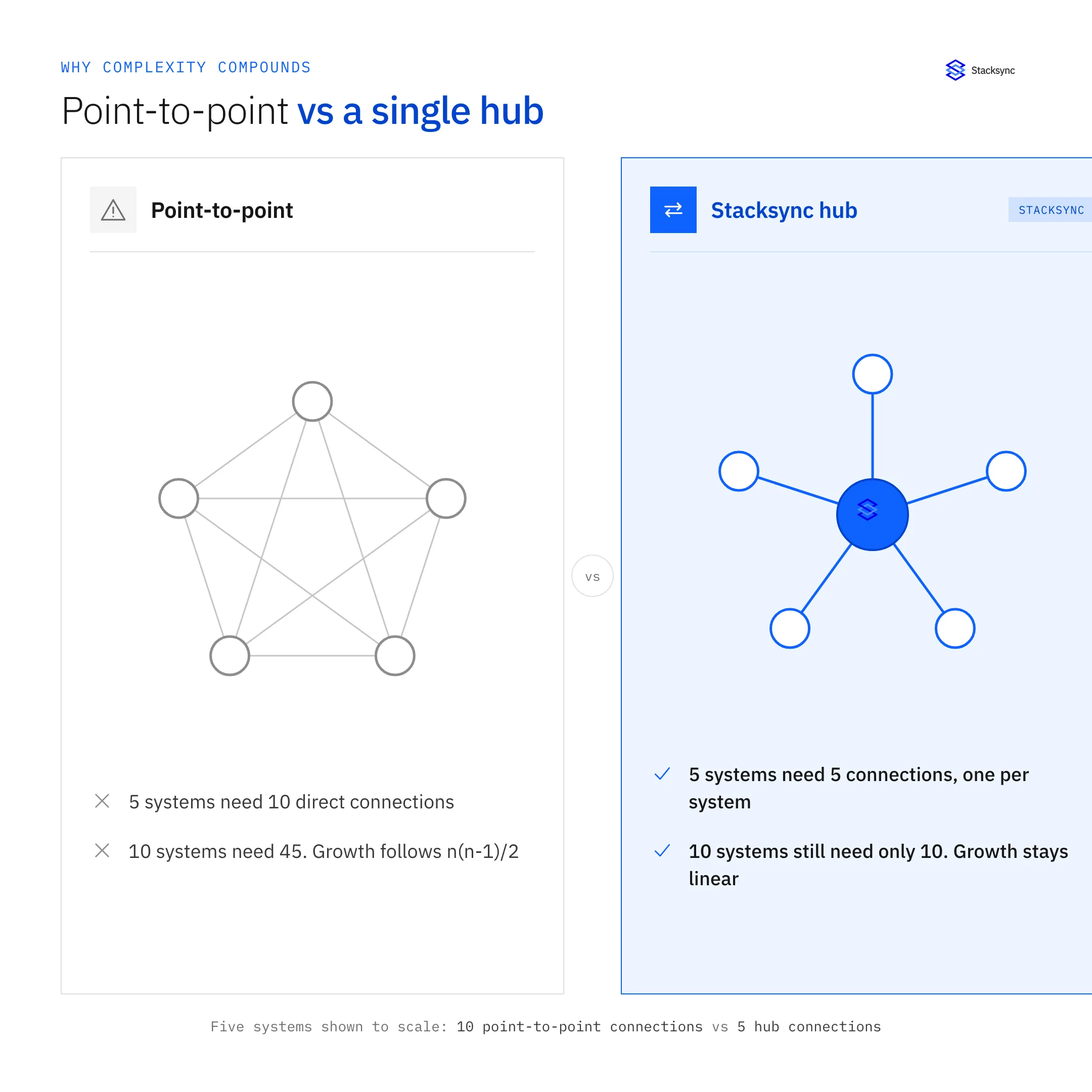
Ten systems in hub-and-spoke topology require ten connections instead of 45, reducing initial development effort and ongoing maintenance burden proportionally. However, hub implementations introduce new challenges around single point of failure, scaling bottlenecks, and hub maintenance complexity.
Database-Centric Synchronization
Database-centric platforms eliminate integration connections entirely by synchronizing data through customer-controlled databases. Each system connects to the platform once, which maintains bidirectional synchronization without requiring systems to communicate directly.
Architectural benefits:
- 01Linear complexity growth as each new system adds one connection
- 02Centralized credential management reducing rotation overhead
- 03Unified monitoring and alerting across all synchronized systems
- 04Consistent error handling and retry logic
- 05Database-level transaction guarantees and conflict resolution
Platforms like Stacksync implement this approach, enabling organizations to add systems without quadratic complexity increases. The platform handles synchronization complexity internally while exposing simple configuration interfaces to users.
Event-Driven Architectures
Event streaming platforms decouple producers from consumers through message brokers. Systems publish events to topics without knowing which downstream consumers subscribe, reducing direct dependencies.
Event-driven complexity considerations:
- 01Schema evolution challenges across multiple consumer versions
- 02Event ordering guarantees require careful broker configuration
- 03Exactly-once processing semantics demand idempotent consumers
- 04Monitoring distributed event flows across async boundaries
- 05Debugging failures lacking direct request-response traces
While event architectures provide valuable decoupling, they introduce new complexity dimensions requiring specialized expertise and operational overhead.

Practical Migration Strategies
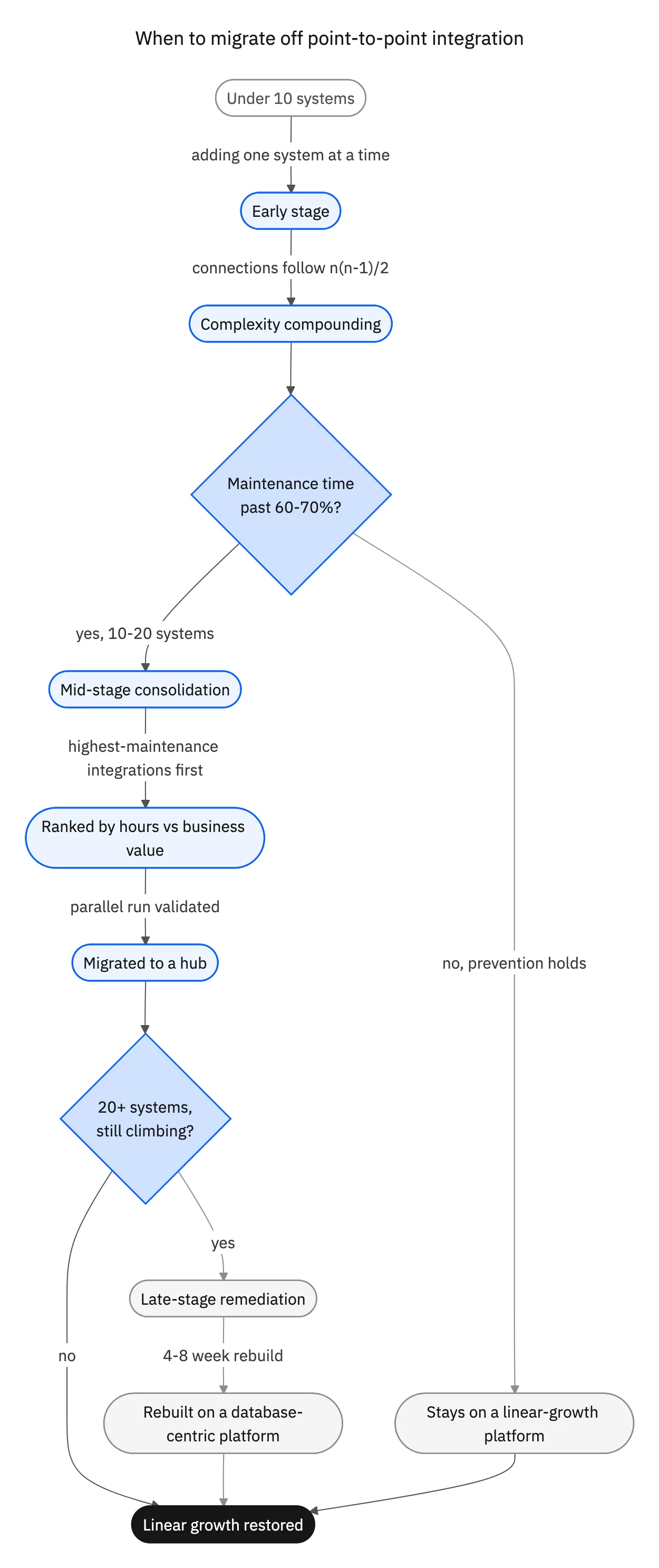
Organizations recognize integration complexity problems at different maturity stages requiring tailored approaches.
Early-Stage Prevention
Companies with fewer than ten systems should establish architectural patterns preventing future complexity accumulation. Selecting integration platforms supporting linear complexity growth avoids costly refactoring later.
Decision criteria for early-stage companies:
- 01Does the platform scale to anticipated system count without geometric complexity?
- 02Can non-engineers configure new integrations reducing development bottlenecks?
- 03Does the solution provide built-in monitoring and reconciliation?
- 04Are credentials managed centrally with automated rotation?
- 05Does the vendor offer implementation support and onboarding?
Mid-Stage Consolidation
Organizations operating 10-20 systems with existing point-to-point integrations benefit from gradual consolidation. IT Migration Services can help teams identify the highest-maintenance integrations first, demonstrate value, and build internal expertise.
Prioritization framework for migration:
- 01Identify integrations requiring most frequent maintenance interventions
- 02Calculate engineering hours consumed by each integration annually
- 03Assess business criticality and uptime requirements
- 04Evaluate data volume and synchronization frequency
- 05Rank by ratio of maintenance cost to business value
Platforms offering parallel run capabilities enable validation before cutting over production traffic, reducing migration risk.
Late-Stage Remediation
Companies with 20+ systems experiencing acute maintenance pain require aggressive remediation timelines. Dedicating team resources to wholesale migration often proves faster than continued point-to-point maintenance.
Organizations successfully migrating from complex point-to-point architectures to unified platforms report 60-80% reductions in integration maintenance hours within three months. Recovered engineering capacity redirects to feature development and strategic initiatives previously postponed due to maintenance burden.
Database-centric platforms like Stacksync enable rapid migration through pre-built connectors for common business systems. Implementation timelines averaging 4-8 weeks for core integrations compare favorably to 6-12 month point-to-point refactoring projects.
When Integration Math Stops Working
Quadratic integration growth is not a tooling problem. It is a structural consequence of point-to-point architectures that were never designed for modern system sprawl. As long as each new application introduces multiple new connections, complexity will always outpace the business systems it supports.
Some teams address this by changing the unit of integration entirely. Instead of connecting systems to each other, they synchronize systems through a shared data layer where state, consistency, and health are centrally observable. In these models, adding a new system increases complexity linearly and reduces the need for custom glue code across the stack.
If integration maintenance is consuming more time than product development, it may be worth exploring database-centric platforms like Stacksync that collapse n(n-1)/2 connections into a single, manageable integration surface. Not as a disruptive rewrite, but as a way to test whether complexity can be reduced instead of continuously managed.
When integration math starts working against you, the next step is not better documentation, but a different architectural baseline.

FAQ
Frequently asked questions










Related articles