EDI Integration for Third Party Logistics Providers: Building Real-Time Supply Chain Visibility
Learn how EDI integration for third party logistics providers improves shipment visibility, billing accuracy, and real-time supply chain performance.
- Author
- Ruben Burdin · Founder & CEO
- Published
- Updated
- Read time
- 6 min read
What Is EDI Integration for Third Party Logistics Providers?
EDI integration for third party logistics providers connects transportation management systems, warehouse management systems, ERPs, and customer platforms through automated electronic data interchange. It enables real-time exchange of purchase orders, shipment notices, invoices, and inventory updates between 3PLs and their trading partners.
For modern 3PLs, EDI integration is not optional. It is foundational to operational efficiency, compliance, and customer retention.
Why EDI Is Critical for 3PL Operations
Third party logistics providers operate at the center of complex supply chains. They coordinate between manufacturers, retailers, carriers, and warehouses while managing thousands of daily transactions.
Without robust EDI integration, 3PLs face:
- Manual order entry and duplicate data handling
- Delayed shipment confirmations
- Inventory discrepancies across client systems
- Retail compliance penalties
- Limited real-time visibility for customers
Because 3PLs act as data intermediaries, integration errors multiply quickly across partners.
Core EDI Transactions Used by 3PLs
Most logistics providers rely on a standardized set of EDI documents to manage operations.
- EDI 204 Motor Carrier Load Tender
- EDI 214 Transportation Carrier Shipment Status
- EDI 210 Freight Invoice
- EDI 940 Warehouse Shipping Order
- EDI 945 Warehouse Shipping Advice
- EDI 856 Advance Ship Notice
- EDI 810 Invoice
Accurate and timely processing of these documents determines whether shipments move smoothly or stall.
The Operational Risks of Poor EDI Integration
When EDI integration is batch-based or partially manual, 3PLs experience cascading issues.
Inventory Misalignment
Warehouse management systems may not reflect real-time shipment updates, causing stock inaccuracies across client portals.
Billing Delays
Freight invoices delayed due to validation errors directly impact cash flow and Days Sales Outstanding.
SLA Violations
Retailers impose strict timing requirements for ASNs and shipment confirmations. Late transmissions trigger penalties.
Customer Dissatisfaction
Clients expect live shipment visibility. Delayed EDI updates damage trust and competitive positioning.
Batch vs Real-Time EDI Integration for 3PLs
| Integration Model | Data Latency | Operational Impact | Revenue Risk |
|---|---|---|---|
| Manual + Batch EDI | 15–60 minute delays between updates | Inventory mismatches and heavy manual reconciliation | High risk of penalties and chargebacks |
| One-Way API Sync | Partial visibility with delayed downstream updates | Data inconsistencies across ERP, WMS, and partner systems | Medium compliance and revenue risk |
| Real-Time Bi-Directional EDI | Sub-second updates across connected systems | Accurate inventory, shipment tracking, and status alignment | Reduced compliance exposure and financial risk |
Key Takeaways
Manual and batch EDI models introduce latency that leads to inventory discrepancies, reconciliation overhead, and higher penalty exposure for 3PLs.
One-way API integrations improve automation but still create blind spots when updates are not reflected across all systems.
Real-time bi-directional EDI ensures continuous synchronization, protecting revenue, improving shipment accuracy, and reducing compliance risk.
For high-volume logistics providers, latency compounds quickly across thousands of transactions.
Architecture Best Practices for 3PL EDI Integration
Modern 3PLs are shifting from file-based EDI gateways to real-time integration layers that connect directly to databases and operational systems.
Best practices include:
- Decoupling EDI translation from ERP logic
- Parsing EDI documents directly into structured database tables
- Enabling bi-directional synchronization between WMS, TMS, and client systems
- Implementing event-driven alerts for exceptions only
- Monitoring API rate limits and compliance status continuously
Platforms built for real-time synchronization eliminate the traditional batch windows that slow fulfillment cycles.
According to the Stacksync enterprise architecture analysis, modern integration platforms prioritize real-time, two-way synchronization to maintain operational data consistency across CRMs, ERPs, and databases. This architectural shift is especially relevant for logistics environments where shipment data changes continuously.
Benefits of Modern EDI Integration for 3PLs
Faster Fulfillment Cycles
Real-time shipment confirmations reduce processing time between order tender and dispatch.
Improved Cash Flow
Automated invoice validation accelerates freight billing and reduces disputes.
Reduced Compliance Penalties
Continuous synchronization ensures ASN timing accuracy and retail compliance.
Scalable Partner Onboarding
Pre-built connectors allow 3PLs to onboard new retail or manufacturing partners in days instead of months.
Enhanced Customer Visibility
Clients receive real-time tracking updates without manual reporting.

Implementation Considerations
Before modernizing EDI integration, 3PLs should evaluate:
- Transaction volume per day
- Number of trading partners
- ERP and WMS architecture
- API rate limits
- Compliance requirements
- Required bi-directional data flows
The goal is not simply to connect systems, but to eliminate operational friction and ensure synchronized data across the entire logistics ecosystem.
Apply this in beverages: distributor order line and pallet contents
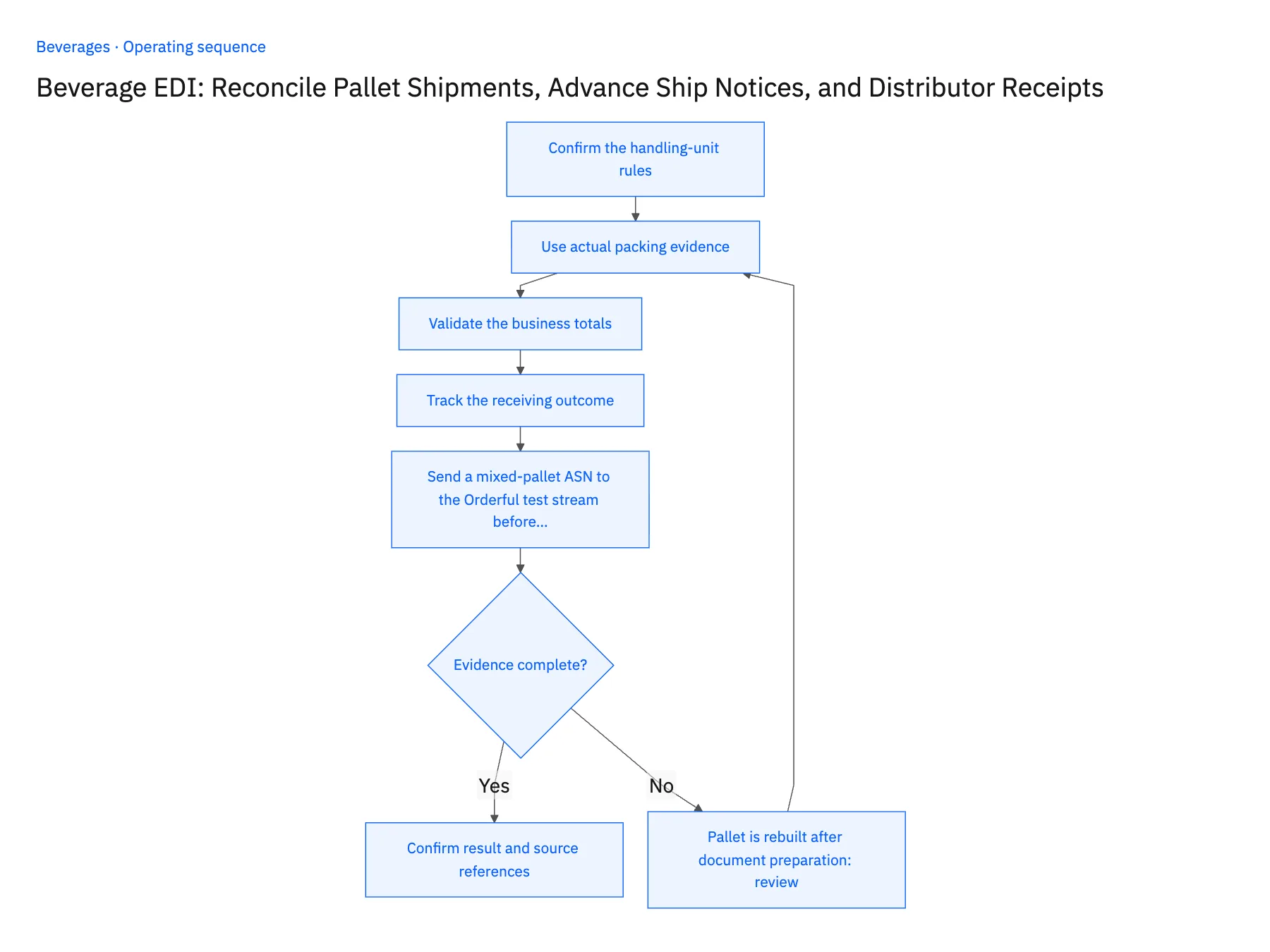
A beverage 3PL must describe the actual case and pallet contents it ships, including mixed pallets and loose cases. Apply the EDI document chain to those handling units, retaining distributor destination and receiving references rather than treating transmission as proof of delivery.
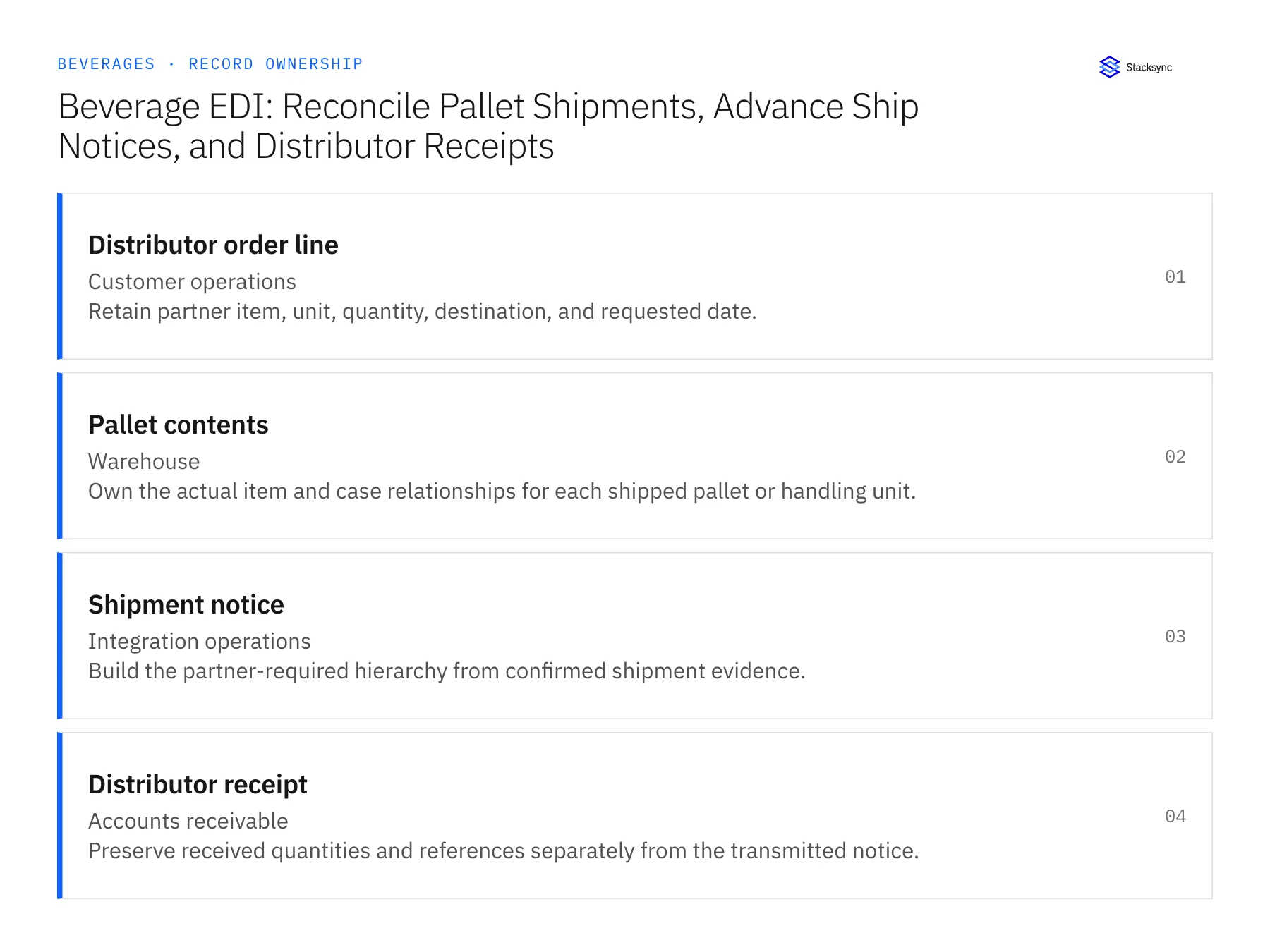
| Record to reconcile | Responsible owner | Rule to preserve |
|---|---|---|
| Distributor order line | Customer operations | Retain partner item, unit, quantity, destination, and requested date. |
| Pallet contents | Warehouse | Own the actual item and case relationships for each shipped pallet or handling unit. |
| Shipment notice | Integration operations | Build the partner-required hierarchy from confirmed shipment evidence. |
An exception to plan for: Pallet is rebuilt after document preparation. Regenerate or correct the affected notice under the partner’s process before relying on it. Acceptance check for the pilot: mixed pallets preserve their item-level case contents.
The beverages hub connects the broader operating context. These guides develop the specific record mappings and decisions for this application:
- Beverage EDI: Reconcile Pallet Shipments, Advance Ship Notices, and Distributor Receipts
- EDI Integration for Beverage Pallets and Distributor Shipments
Logistics Growth Depends on Data Precision
Third party logistics providers operate on tight margins and strict service-level agreements. Delayed or inaccurate EDI data directly impacts revenue, reputation, and retention.
Organizations that modernize EDI integration move from reactive reconciliation to proactive, real-time logistics management. In competitive supply chain environments, precision and speed define market leadership.
FAQ
Frequently asked questions










Related articles