

















EDI Compliance Issues with Retail Trading Partners (2026 Guide)
Learn the top EDI compliance issues with retail trading partners, why chargebacks happen, and how real-time validation prevents costly retail penalties.
- Author
- Ruben Burdin · Founder & CEO
- Published
- Updated
- Read time
- 6 min read

Retail EDI compliance issues happen when suppliers fail to meet a retailer’s specific Electronic Data Interchange requirements for documents, formats, timing, or acknowledgments. The result is chargebacks, rejected shipments, delayed payments, and damaged relationships. Preventing these issues requires strict validation, real-time monitoring, and tight system integration.
Why EDI Compliance Matters in Retail
Retailers operate high-volume, low-margin supply chains. To maintain efficiency, they enforce strict EDI guidelines covering document standards, transmission timing, labeling, and acknowledgments.
When suppliers miss a requirement, retailers automatically trigger penalties. These penalties often come as:
- Chargebacks deducted from invoices
- Shipment rejections at distribution centers
- Delayed payments
- Vendor scorecard downgrades
- Increased audit scrutiny
In large retail ecosystems, even small EDI errors can cost suppliers 1–3% of annual revenue in penalties.
Most Common EDI Compliance Issues with Retail Trading Partners
1. Incorrect EDI Document Format
Retailers typically require ANSI X12 or EDIFACT formats with strict implementation guides. Common errors include:
- Missing mandatory segments
- Incorrect qualifiers
- Invalid product identifiers (UPC, GTIN)
- Improper PO number references
Even when a document is technically valid EDI, it may still be non-compliant with a specific retailer’s mapping requirements.
2. Late or Missing Functional Acknowledgments (997 / 999)
Retailers expect timely acknowledgments confirming receipt and validation of documents.
Failure to return 997 or 999 acknowledgments within the required window can trigger automatic compliance violations.
3. Advanced Ship Notice (ASN 856) Errors
ASN accuracy is one of the most frequent sources of retail penalties. Issues include:
- Incorrect carton counts
- Mismatched quantities vs. purchase order
- Wrong SSCC labels
- Timing mismatches between shipment and ASN transmission
Retailers rely on ASN data for warehouse automation. Any mismatch disrupts receiving operations.
4. Invoice (810) Discrepancies
Retail invoice compliance errors often involve:
- Price mismatches
- Freight terms inconsistencies
- Incorrect allowance deductions
- Missing tax breakdowns
If invoice data does not perfectly match PO and ASN data, retailers may short pay or issue chargebacks.
5. Retailer-Specific Implementation Variations
Each trading partner has its own EDI implementation guide. Even when documents use the same X12 standard, segment requirements differ.
Suppliers managing multiple retailers must maintain multiple custom mappings, increasing complexity and error risk.
How Batch Processing Creates Compliance Gaps
Many legacy EDI environments rely on scheduled batch jobs. These jobs may run every 15, 30, or 60 minutes.
This creates risk windows where:
- Orders are updated but ASNs are not regenerated
- Inventory changes after EDI extraction
- Invoice data differs from the latest PO version
Retail trading partners do not tolerate these timing gaps. Their systems expect near real-time accuracy.
Modernizing Retail EDI Architecture
Retail EDI modernization does not require replacing ERP systems. Instead, it requires decoupling translation logic from operational systems and enabling real-time data synchronization.
A modern architecture typically includes:
- 01Direct parsing of EDI documents into structured database tables
- 02Real-time validation rules against retailer-specific requirements
- 03Bi-directional sync between ERP, WMS, and EDI layers
- 04Automated alerting before documents reach the retailer
Transforming EDI into structured, queryable data allows operations and finance teams to detect compliance risks before they become penalties.
According to the Stacksync enterprise integration analysis fileciteturn0file0, real-time, bi-directional synchronization eliminates the latency and data divergence common in batch-oriented integrations. When applied to EDI workflows, this approach prevents discrepancies between operational systems and outbound retail documents.
Best Practices to Reduce Retail EDI Chargebacks
Standardize Internal Data Before Transmission
Ensure product identifiers, pricing tables, and freight rules are consistent across ERP and warehouse systems before EDI generation.
Validate Against Retailer Rules Pre-Submission
Implement automated validation checks for each retailer’s implementation guide before documents are transmitted.
Replace Batch Windows with Real-Time Sync
Move from periodic data exports to real-time synchronization between systems to eliminate timing discrepancies.
Monitor Vendor Scorecards Proactively
Track retailer compliance metrics weekly. Early detection prevents compounding penalties.
Centralize Trading Partner Logic
Avoid hard-coded custom mappings scattered across systems. Maintain a centralized rule engine or integration layer.

The Strategic Cost of Ignoring EDI Compliance
Retailers use compliance scorecards to determine preferred vendor status. Chronic violations can lead to:
- Reduced order volume
- Tighter payment terms
- Increased audits
- Contract renegotiation disadvantages
EDI compliance is no longer just a technical requirement. It directly affects revenue stability and long-term retail relationships.
Apply this in personal care: retailer item code and partner order line
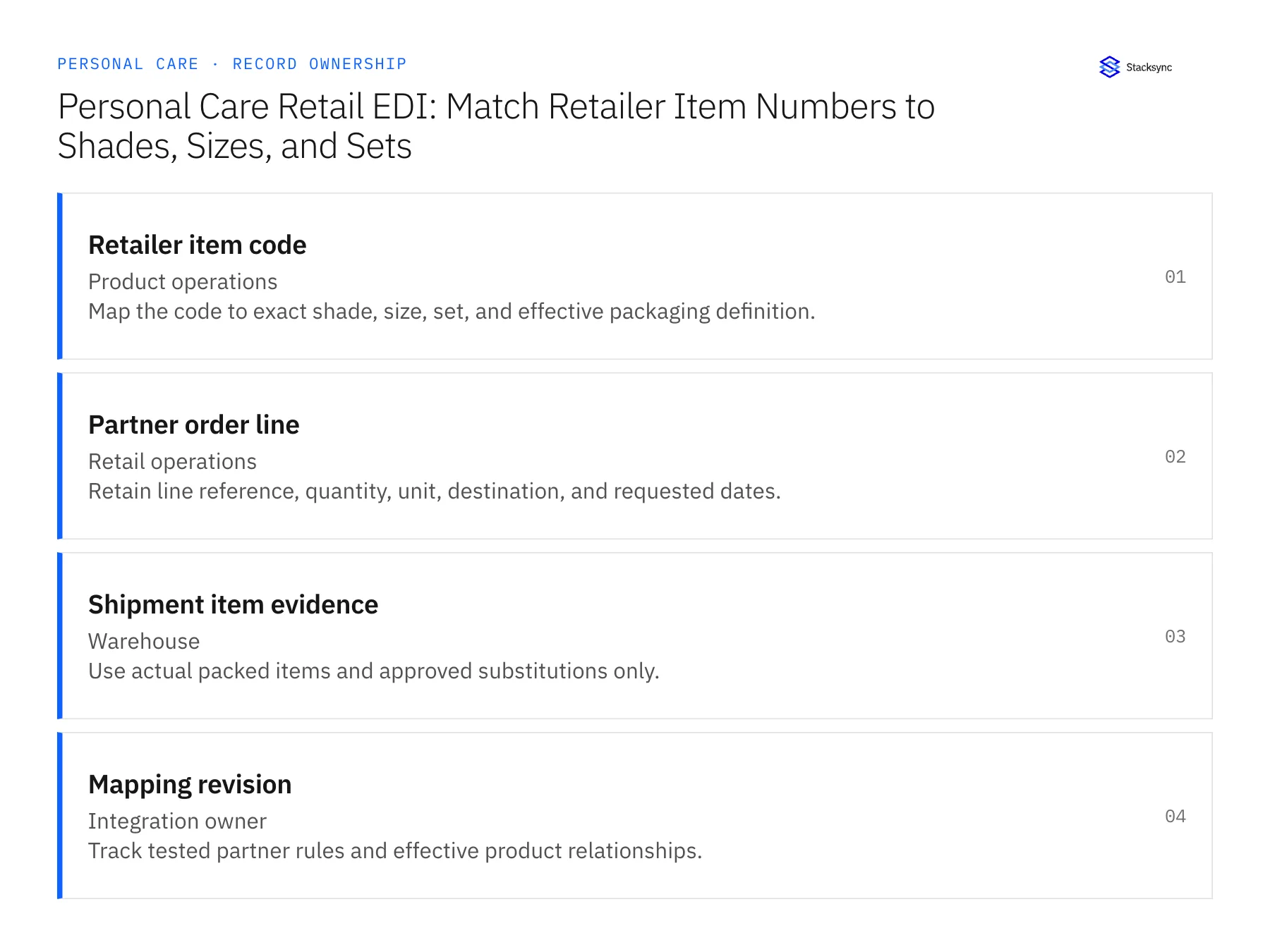
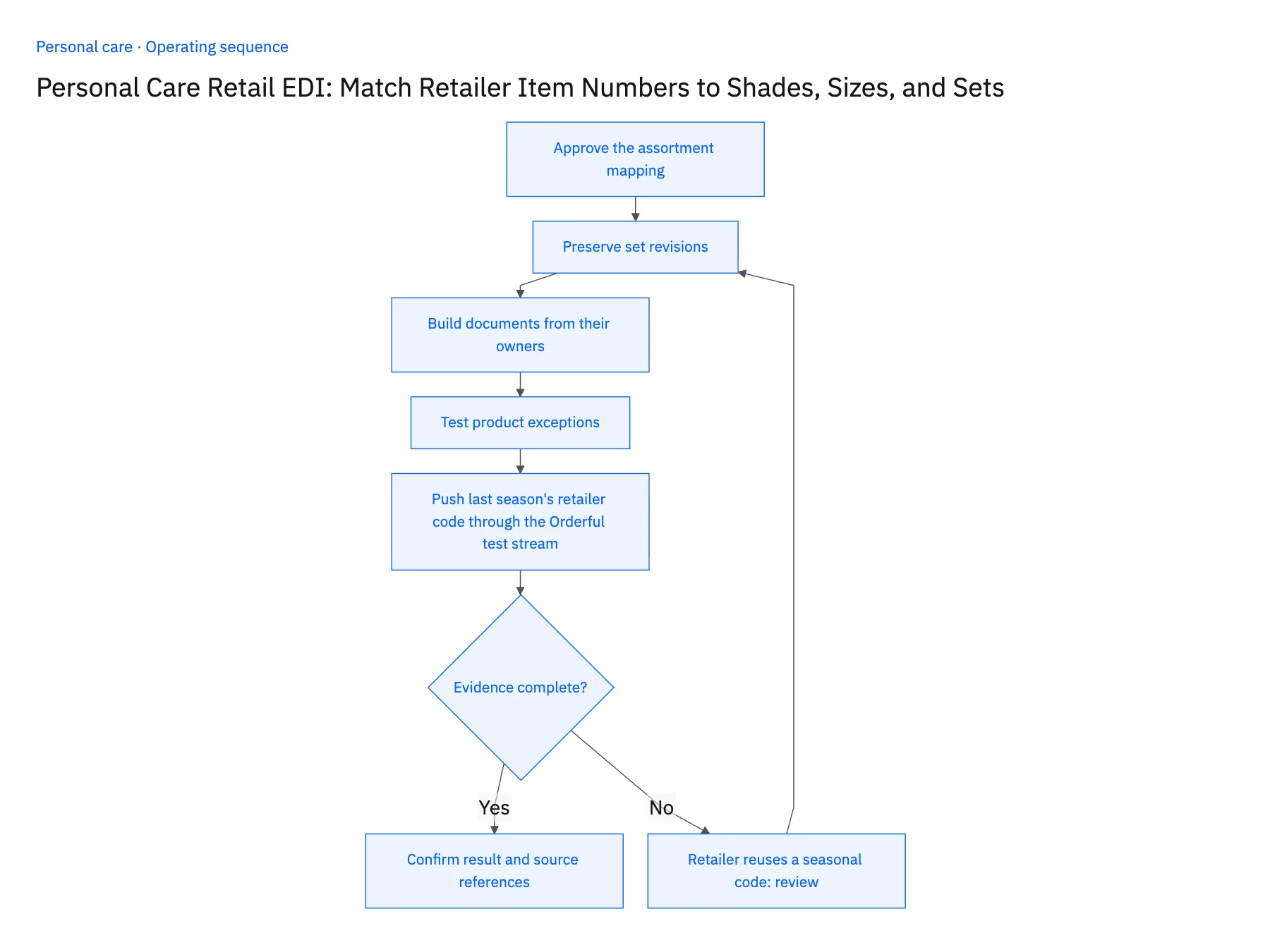
Personal-care retailer mapping must identify the exact shade, size, set, and packaging revision behind each partner item number. Add those business checks to technical EDI validation so a correctly formatted document cannot silently describe the wrong sellable product.
| Record to reconcile | Responsible owner | Rule to preserve |
|---|---|---|
| Retailer item code | Product operations | Map the code to exact shade, size, set, and effective packaging definition. |
| Partner order line | Retail operations | Retain line reference, quantity, unit, destination, and requested dates. |
| Shipment item evidence | Warehouse | Use actual packed items and approved substitutions only. |
An exception to plan for: Retailer reuses a seasonal code. Confirm the effective set definition instead of rewriting historical orders. Acceptance check for the pilot: every retailer item resolves to the intended shade, size, or set revision.
The personal care hub connects the broader operating context. These guides develop the specific record mappings and decisions for this application:
Retail EDI Compliance Is an Operational Discipline, Not Just a File Format
Suppliers that treat EDI as a simple document translation process continue absorbing chargebacks and operational friction. Retail trading partners expect synchronized, validated, real-time data.
Organizations that modernize their integration layer, eliminate batch windows, and enforce upstream data accuracy reduce penalties, improve retailer scorecards, and protect margins.
If retail EDI errors are affecting your operations, start by evaluating how data moves between your ERP, warehouse, and EDI systems. The real problem often lies in synchronization, not formatting.
FAQ
Frequently asked questions










Related articles