

















E-commerce at Scale: Sync Supabase, Shopify & NetSuite in Real-Time
Eliminate overselling with real-time 3-way sync between Supabase product catalogs, Shopify storefronts, and NetSuite ERP. Maintain perfect inventory accuracy during peak season.
- Author
- Ruben Burdin · Founder & CEO
- Published
- Updated
- Read time
- 22 min read

Modern e-commerce operations require sophisticated integration strategies that go beyond basic point-to-point connections. Your Supabase product catalog powers custom features. Your Shopify storefront drives customer transactions. Your NetSuite ERP manages fulfillment and financials. When these systems fall out of sync, the consequences ripple across your entire operation.
Black Friday 2024 demonstrated the scale: U.S. consumers spent $10.8 billion online in a single day, with peak spending hitting $5.1 million per minute. European retailers processed 11.4 orders per second, a 205% surge over typical volumes. During these critical moments, inventory sync delays of even 15-30 minutes trigger catastrophic overselling, while manual reconciliation across three systems becomes impossible.
This article explores how three-way synchronization enables e-commerce businesses to maintain perfect data consistency across their technology stack, prevent costly overselling during peak demand, and deliver the real-time accuracy that modern customers expect.
The Three-System E-commerce Stack Reality
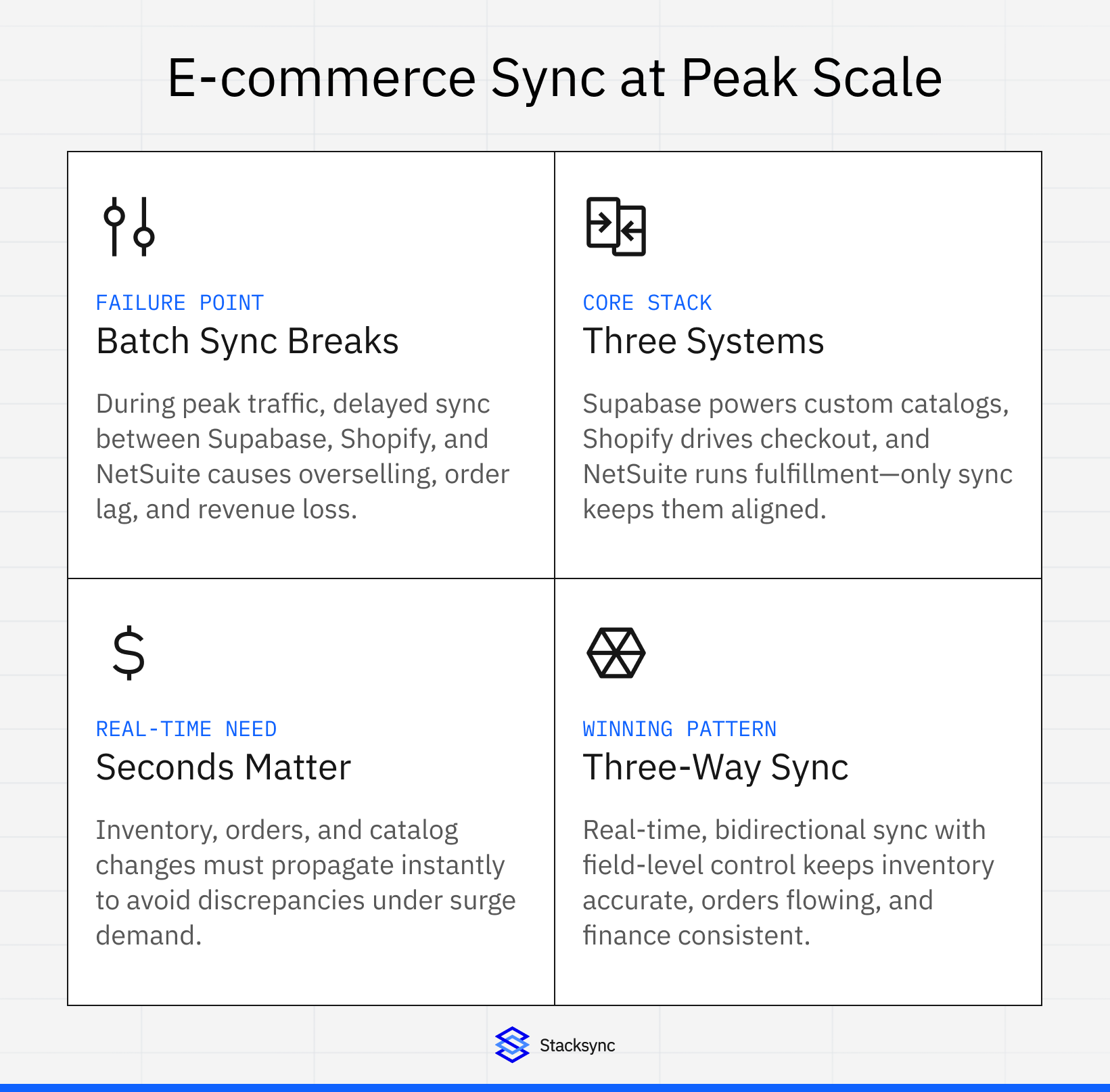
Modern e-commerce operations typically distribute responsibilities across specialized platforms, each optimized for distinct functions. Supabase provides a flexible PostgreSQL database for custom product catalogs, enriched attributes, and application-specific logic. Shopify delivers the storefront experience with optimized checkout flows and customer-facing inventory displays. NetSuite orchestrates the order-to-cash cycle, from fulfillment workflows to financial reconciliation.
Development teams build custom features against Supabase without Shopify's platform constraints. Marketing teams update storefronts through Shopify's interface without touching backend databases. Finance teams track revenue recognition in NetSuite without navigating technical systems. Each platform excels at its specific function.
Product data originates in Supabase but must display accurately on Shopify. Orders placed through Shopify trigger fulfillment workflows in NetSuite. Inventory updates from NetSuite must propagate back to both Shopify and Supabase. A single product update cascades through three systems, each with different data models, API constraints, and update frequencies.
Traditional batch synchronization approaches process updates every 15-30 minutes. During normal operations, many businesses tolerate this delay without recognizing its hidden costs. During Black Friday, when Shopify merchants processed $4.6 million per minute at peak, 15-minute sync windows become business-critical failures. Products sell out on Shopify while Supabase still shows availability. NetSuite fulfillment queues overflow with orders the system hasn't received. Financial reconciliation breaks when systems disagree on what sold when.
Critical Failure Points in Three-Way Synchronization Under Peak Load
E-commerce synchronization failures follow predictable patterns amplified by peak season volume.
Inventory Discrepancies Triggering Overselling
Shopify's native architecture lacks real-time synchronization with external systems. Updates occur through polling mechanisms checking for changes at scheduled intervals. Most integration platforms implement 15-30 minute sync cycles for inventory levels. During high-velocity sales periods, this creates dangerous gaps.
A product shows 10 units available on Shopify at 10:00 AM. Between 10:00 and 10:15, customers purchase 12 units. Shopify accepts all orders because its local inventory count hasn't synchronized with NetSuite's authoritative stock level. At 10:15, the batch sync runs, discovering the discrepancy. Your fulfillment team now faces 2 cancelled orders, disappointed customers, and potential chargebacks.
66% of consumers reduce trust in businesses after experiencing overselling. With 87.3 million Americans shopping online on Black Friday alone, even a 1% overselling rate translates to hundreds of thousands of negative customer experiences during peak season.
Variant complexity significantly amplifies inventory synchronization challenges. A single product with size and color options might represent 20 SKUs in Supabase. Shopify displays aggregate availability across variants. NetSuite tracks individual SKU locations across warehouses. Synchronizing three-way inventory requires mapping these different structural representations without creating discrepancies. Batch processing handles this poorly under load, as each system updates on independent schedules.
Order Data Fragmentation Across Systems
The order-to-cash cycle in NetSuite encompasses multiple stages: order capture, credit approval, inventory allocation, fulfillment scheduling, shipment generation, invoice creation, and payment collection. Each stage updates order status, triggering downstream workflows. Without real-time synchronization, Shopify displays outdated order information while NetSuite processes fulfillment.
Modern e-commerce customers have come to expect real-time order tracking accuracy, with studies showing that 70% of online shoppers check order status multiple times before delivery. A Shopify order placed at 2:00 PM enters NetSuite's fulfillment queue via batch sync at 2:30 PM. Warehouse staff pick and pack the order at 3:00 PM. The shipment confirmation syncs back to Shopify at 3:30 PM. From the customer's perspective, their order shows "processing" for 90 minutes after it's actually shipped.
During Cyber Monday 2024, when consumers spent $13.3 billion online in the U.S., this 90-minute information lag affects millions of orders. Customer service teams field "where's my order" inquiries for packages already in transit. The support load compounds operational costs precisely when revenue peaks.
Order data includes customer information, shipping addresses, payment details, line items, pricing, taxes, and promotional codes. Each field must remain consistent across systems. Supabase might store customer preferences and purchase history. Shopify captures payment authorization. NetSuite tracks revenue recognition and fulfillment costs. Batch synchronization risks data conflicts when customers modify orders between sync windows. The last-write-wins approach typical of batch systems can overwrite legitimate updates with stale data.
Product Catalog Drift Creating Channel Inconsistencies
Product catalogs contain hundreds to thousands of attributes per SKU: titles, descriptions, specifications, images, videos, pricing, variants, categories, tags, SEO metadata, and custom fields. Managing this information across three systems without synchronization infrastructure creates inevitable drift.
Marketing teams update product descriptions in Shopify for seasonal campaigns. Development teams add new attributes in Supabase to support custom features. Finance teams adjust pricing in NetSuite based on cost changes. Without immediate propagation, the same product displays different information depending on where customers view it.
50% of Google account suspensions and product disapprovals stem from price or availability errors detected during catalog crawls. When product data differs between your Shopify storefront and backend systems, automated channel compliance monitoring flags discrepancies. Amazon, Walmart, and Google Shopping all penalize inconsistent data by suppressing product listings, directly impacting discoverability during peak shopping periods.
Merchants managing 10,000+ products across multiple categories face exponential complexity. Each product requires synchronization of base attributes plus variant-specific details. Manual CSV exports and imports become operationally impossible. Catalog management platforms help organize data but still require synchronization mechanisms to propagate changes across the three-system architecture.
Peak Season Cascading Failures
E-commerce peak season reveals the critical importance of robust synchronization infrastructure that performs reliably under extreme load conditions. Black Friday 2024 volume: Cyber Week generated $41.1 billion in online sales across five days. Order volumes increased 36-680% depending on product category. Mobile commerce drove 70% of global sales, with 80% of buy-now-pay-later transactions occurring on mobile devices.
During flash sales and promotional periods, inventory moves faster than batch sync cycles can track. A popular item with 100 units sells out in 8 minutes at peak velocity. Systems operating on 15-minute sync windows accept orders for 7 additional minutes after actual sellout. The resulting cancellation rate spikes, cart abandonment increases, and customer acquisition costs rise as marketing spend drives traffic that converts to disappointed customers rather than revenue.
NetSuite's order-to-cash automation provides significant advantages during normal volumes. The platform manages complex approval workflows, automatically determines optimal fulfillment locations, and integrates shipping information across carriers. These capabilities break when order queues overwhelm API rate limits. Systems designed for steady-state processing struggle with burst traffic patterns where an hour's worth of typical orders arrive in 3 minutes.
Shopify's infrastructure handles traffic spikes well, processing millions of concurrent shoppers without performance degradation. The bottleneck emerges at the integration layer. External systems receiving order feeds via webhook or API polling must scale to match Shopify's throughput. NetSuite instances provisioned for average load cannot process 10x order velocity without queue delays. The lag between order placement on Shopify and order appearance in NetSuite extends from minutes to hours, making time-sensitive fulfillment promises impossible to honor.
The Supabase Product Catalog Advantage
Supabase's PostgreSQL foundation offers significant flexibility for custom data models, and Stacksync removes the integration barriers that prevent businesses from fully leveraging this capability alongside Shopify and NetSuite.
Standard e-commerce platforms implement standardized product schemas optimized for general retail use cases. Custom attributes require workarounds. Relational data between products, collections, and categories follows platform-defined structures. Complex pricing logic runs through platform-specific APIs with inherent limitations. These constraints limit businesses requiring custom product data models.
Supabase eliminates these restrictions. Development teams design product tables matching exact business requirements. A fashion retailer might store fabric composition, care instructions, sustainability certifications, and designer collaborations in custom fields. A B2B electronics supplier implements tiered pricing based on customer segments, order volume, and contractual agreements. An omnichannel furniture brand tracks inventory across showrooms with location-specific pricing and availability.
Supabase real-time capabilities enable instant product data updates through websocket subscriptions. Changes to product records publish through websocket subscriptions, enabling instant UI updates without polling. Custom applications built against Supabase databases receive immediate notifications when inventory adjusts, prices change, or new products launch. This real-time foundation makes Supabase ideal as the authoritative product catalog in three-way synchronization architectures.
While Supabase excels as a flexible database foundation, complete e-commerce operations require complementary platforms for storefront management and order fulfillment. It lacks native storefront components, checkout flows, payment processing, and shipping integrations. These capabilities belong in specialized systems like Shopify. Similarly, Supabase doesn't provide ERP functionality for order management, fulfillment workflows, and financial operations. These requirements justify NetSuite. The three systems become necessary components of a complete e-commerce stack.
The challenge becomes maintaining perfect consistency between Supabase's flexible product catalog, Shopify's customer-facing storefront, and NetSuite's operational backend. Traditional integration platforms treat these as independent systems connected by periodic synchronization jobs. Real-time e-commerce requires architectural patterns that maintain sub-second consistency across all three systems simultaneously.
Three-Way Synchronization Architecture Patterns
Maintaining data consistency across Supabase, Shopify, and NetSuite requires purpose-built synchronization infrastructure. Standard approaches fail under e-commerce's specific constraints: high transaction velocity, complex data models, strict consistency requirements, and zero-tolerance for overselling.
Hub-and-Spoke vs. Mesh Synchronization
Organizations implementing three-system synchronization must choose between two fundamental architectural approaches, each offering distinct advantages for different operational requirements: hub-and-spoke and full mesh architectures.
Hub-and-spoke designates one system as the authoritative source, with other systems synchronizing through this central hub. For product-centric e-commerce, Supabase serves as the product master. Changes to product data occur in Supabase, then propagate to both Shopify and NetSuite. This creates clear data ownership and simplifies conflict resolution. Updates flow unidirectionally from Supabase outward, eliminating circular dependency issues.
However, hub-and-spoke introduces synchronization lag. When NetSuite receives a shipment and increments inventory, the update must travel to Supabase before propagating to Shopify. This doubles synchronization latency compared to direct NetSuite-to-Shopify updates. During high-velocity inventory movements, the additional hop creates reconciliation windows where systems disagree on stock levels.
Full mesh architecture synchronizes all three systems bidirectionally. Supabase, Shopify, and NetSuite each update the others when changes occur locally. Product updates from Supabase sync to both Shopify and NetSuite simultaneously. Order captures from Shopify sync to both Supabase and NetSuite immediately. Inventory adjustments from NetSuite propagate to both Supabase and Shopify in parallel.
Full mesh synchronization delivers minimal latency by enabling direct system-to-system updates, though this approach requires sophisticated conflict resolution logic to maintain data consistency when simultaneous updates occur across multiple systems. When systems update the same record simultaneously, the synchronization engine must determine winning values without data loss. Last-write-wins strategies risk discarding legitimate updates. Merge logic requires understanding business semantics for each field type. Price changes should overwrite. Inventory adjustments should sum. Customer addresses should preserve most recent. Implementing these rules correctly demands deep integration logic.
For e-commerce at scale, hybrid approaches balance consistency, performance, and operational simplicity. Product catalog updates flow hub-and-spoke through Supabase as the master. Inventory updates use mesh synchronization for minimal latency. Order data synchronizes Shopify-to-NetSuite directly while also updating Supabase for analytics. This balances consistency, performance, and operational simplicity based on data type characteristics.
Real-Time Change Data Capture
Batch synchronization operates by polling systems for changes at scheduled intervals, typically every 15-30 minutes. Every 15 minutes, the integration platform queries Supabase for updated products, checks Shopify for new orders, and retrieves NetSuite inventory adjustments. This approach scales poorly, introducing 15-30 minute latency incompatible with real-time e-commerce requirements.
Change Data Capture monitors database transactions, detecting modifications as they occur. When a product record updates in Supabase, CDC immediately captures the change without polling. The synchronization engine receives notification in milliseconds rather than minutes, processing updates while data remains fresh.
Supabase provides native CDC through PostgreSQL's logical replication. Every insert, update, and delete on product tables generates change events published through real-time channels. Applications subscribe to these channels, receiving immediate notifications when product data changes. This eliminates polling overhead and delivers sub-100ms synchronization latency.
Shopify and NetSuite require different CDC approaches. Shopify publishes webhook events when orders, inventory, and products change. Subscribing to these webhooks provides near-instant notification of storefront changes. NetSuite SuiteTalk API supports SuiteScript triggers on record modifications, generating events for ERP-side updates. Configuring comprehensive webhook coverage across both platforms ensures no change goes undetected.
CDC-driven synchronization processes only actual changes, eliminating polling overhead. Batch systems waste resources checking for updates that don't exist 90% of the time. CDC systems remain idle until actual modifications trigger processing. During slow periods, this dramatically reduces infrastructure costs. During peak periods, CDC ensures immediate processing regardless of update velocity.
Field-Level Mapping and Transformation
Synchronizing data across three systems—each with distinct data models, field structures, and business logic—requires sophisticated transformation capabilities that accurately map and convert information between platforms. Supabase stores product data in custom PostgreSQL schemas. Shopify uses its platform-specific product object model. NetSuite maintains Item records with ERP-specific fields. Mapping between these representations demands precise field-level configuration.
A single product in Supabase might map to multiple Shopify variants. The Supabase table stores base product details plus variant-specific attributes like size and color in related tables. Shopify's variant model nests these options under a parent product. During synchronization, the engine must query Supabase relationships, construct Shopify variant arrays, and maintain bidirectional mapping for updates traveling both directions.
Pricing presents additional complexity. Supabase might store cost basis, markup percentages, and calculated sell prices. Shopify displays retail price and compare-at price for promotions. NetSuite tracks different pricing tiers for customer segments. The synchronization layer must execute pricing calculations, apply business rules, and ensure displayed prices match financial records without manual reconciliation.
Inventory location tracking exemplifies three-way transformation challenges. NetSuite manages multi-location inventory with warehouse-specific counts. Shopify's multi-location inventory feature expects location IDs mapping to specific fulfillment centers. Supabase might aggregate across locations or track availability differently for custom applications. Synchronizing inventory requires location mapping, aggregation rules, and allocation logic determining which warehouses fulfill which orders.
Field-level filtering prevents unnecessary synchronization traffic. Not every Supabase field belongs in Shopify. Internal cost data, supplier details, and warehouse locations remain backend-only. Similarly, NetSuite's financial accounting fields don't require synchronization to customer-facing systems. Configuring precise field mappings reduces data transfer, improves performance, and maintains security boundaries between systems.
Stacksync for Three-Way E-commerce Synchronization
Three-way synchronization between Supabase, Shopify, and NetSuite requires purpose-built infrastructure. Stacksync delivers this infrastructure through a unified bidirectional architecture that manages synchronization across all three systems from a single configuration interface.
Stacksync implements comprehensive change data capture across PostgreSQL databases, Shopify webhooks, and NetSuite SuiteScript triggers, ensuring that every data modification in any system immediately propagates to connected platforms. Changes in any system propagate to the other two in sub-second latency. Product updates in Supabase appear on Shopify storefronts and NetSuite item records within 100ms. Orders placed through Shopify trigger immediate NetSuite sales orders while also updating Supabase analytics tables. Inventory adjustments in NetSuite cascade to both Shopify availability and Supabase stock counts without manual intervention.
Field-level mapping handles transformation complexity between different data models. Visual configuration tools map Supabase product tables to Shopify product variants without writing transformation code. Pricing calculations execute within synchronization workflows, applying markup rules from Supabase, displaying retail prices in Shopify, and reconciling with NetSuite revenue recognition. Inventory location mapping aggregates NetSuite warehouse counts into Shopify location-specific availability.
Conflict resolution logic prevents data loss when simultaneous updates occur across systems. Price changes always use the most recent value. Inventory updates sum incremental adjustments rather than overwriting totals. Customer information merges changes from all systems, preserving the complete record. These rules execute automatically based on data type and business semantics.
Enterprise monitoring provides visibility into synchronization health across all three systems. Real-time dashboards display sync status, data flow rates, and error conditions. Alerts fire through email, Slack, or PagerDuty when synchronization latency exceeds thresholds or errors require attention. Detailed logs capture every synchronized record with before and after values, enabling precise troubleshooting when discrepancies emerge.
The platform scales to e-commerce peak season demands. Architecture supporting millions of records and hundreds of thousands of daily transactions handles Black Friday traffic spikes without performance degradation. Smart API management respects Shopify and NetSuite rate limits while maintaining real-time synchronization through request queuing and batch optimization.
Stacksync's Pro plan, priced at $3,000 per month, provides 3 active synchronizations and supports up to 1 million records—a configuration specifically designed for three-way e-commerce architectures connecting Supabase, Shopify, and NetSuite.
This covers Supabase-to-Shopify product synchronization, Shopify-to-NetSuite order flow, and NetSuite-to-Supabase inventory updates. Additional syncs and record volumes scale with predictable pricing: $2 per thousand records for the 150k-1M tier, decreasing to $0.10 per thousand above 100 million records.
Engineering teams spending 30-50% of time maintaining custom integrations redirect that capacity to core product development. Customer service teams handling order status inquiries due to sync delays reduce support loads. Revenue lost to overselling during peak seasons gets recovered through real-time inventory accuracy.
Implementation Strategy for Three-Way Sync
Deploying three-way synchronization across Supabase, Shopify, and NetSuite requires phased implementation.
Phase 1: Product Catalog Synchronization
Organizations typically achieve fastest time-to-value by implementing one-way Supabase-to-Shopify product synchronization as the initial phase. Product data typically changes less frequently than orders or inventory, providing stable ground for initial configuration. Map Supabase product tables to Shopify product and variant objects, configuring field transformations for titles, descriptions, pricing, images, and categories.
Conduct thorough testing with a representative subset of products before enabling full catalog synchronization across your entire inventory. Verify pricing calculations match expectations. Confirm image URLs resolve correctly. Validate variant options map properly. Run parallel comparison between manually-updated Shopify products and synchronized versions to ensure equivalence.
Enable real-time product updates once validation completes. Changes to product records in Supabase immediately propagate to Shopify. Marketing teams gain ability to update product information through custom admin panels built against Supabase while changes appear instantly on storefronts. Development cycle time for product data improvements reduces from days to minutes.
Add Supabase-to-NetSuite product synchronization as second sync. This establishes NetSuite item records matching the Supabase product master. Configure mappings for NetSuite-specific fields like cost basis, preferred vendors, and reorder points. Enable synchronization and validate item records appear correctly in NetSuite.
Phase 2: Order Flow Implementation
Implement Shopify-to-NetSuite order synchronization as highest-priority real-time sync. Every order placed through Shopify must immediately create NetSuite sales orders triggering fulfillment workflows. This eliminates manual order entry and reduces order-to-fulfillment latency from 15-30 minutes to under 1 minute.
Configure order mapping translating Shopify order objects to NetSuite sales orders. Map customer information, line items, shipping addresses, payment details, and order-level attributes. Test with small order volumes, validating every Shopify field propagates correctly to NetSuite records.
Set up order status synchronization returning NetSuite fulfillment information to Shopify. When warehouse staff fulfill orders and generate shipments in NetSuite, synchronization updates Shopify order status and triggers customer shipping notifications. This synchronizes order status between NetSuite fulfillment and Shopify customer notifications.
Add Shopify-to-Supabase order synchronization for analytics purposes. Order data flowing into Supabase powers custom reporting dashboards, customer lifetime value calculations, and business intelligence. This sync runs parallel to Shopify-NetSuite order flow without adding latency to operational processes.
Phase 3: Real-Time Inventory Synchronization
Enable NetSuite-to-Shopify inventory synchronization as final critical sync. Inventory synchronization carries the highestrisk because inventory errors directly cause overselling. Implement carefully with extensive validation.
Configure inventory location mapping between NetSuite warehouses and Shopify locations. Determine allocation rules for multi-location inventory, specifying which warehouse fulfills which geographic regions. Set up inventory aggregation logic if Shopify displays total availability across locations.
Start with conservative inventory buffers. Synchronize NetSuite inventory to Shopify minus a safety stock buffer. If NetSuite shows 100 units, sync 95 to Shopify. This creates cushion preventing overselling during synchronization delays or discrepancies. Monitor closely for one week, validating no overselling occurs.
Gradually reduce inventory buffers as confidence builds. Eventually eliminate buffers entirely when real-time synchronization proves reliable. The goal: Shopify displays actual NetSuite availability with zero buffer through sub-second inventory updates.
Add NetSuite-to-Supabase inventory synchronization completing the three-way architecture. Supabase now receives real-time inventory updates for custom applications displaying stock levels. This enables building customer-facing features showing precise availability without querying NetSuite directly.
Phase 4: Monitoring and Optimization
Implement comprehensive monitoring across all six synchronization flows (two directions for each of three systems). Set alert thresholds for synchronization latency, error rates, and record volumes. Configure escalation paths ensuring on-call teams respond quickly when issues emerge.
Review synchronization logs weekly identifying patterns in data discrepancies. Common issues include missing field mappings, incorrect transformations, or business logic gaps. Address these iteratively, improving mapping configurations to minimize synchronization errors.
Optimize API utilization to minimize costs while maintaining real-time performance. Configure field-level filtering excluding unnecessary data from synchronization. Implement intelligent batching for high-volume updates occurring simultaneously. Enable compression for large product catalogs reducing network transfer.
Conduct load testing before peak seasons. Simulate Black Friday order volumes validating synchronization infrastructure scales appropriately. Measure synchronization latency under load confirming it remains within acceptable thresholds. Identify bottlenecks and provision additional capacity proactively.
Phase 5: Business Continuity Planning
Establish fallback procedures for synchronization failures. Define manual processes for critical operations if automated sync becomes unavailable. Document emergency contacts for Stacksync support and internal escalation paths.
Implement health monitoring detecting synchronization degradation before complete failure. Alert thresholds triggering at 2x normal latency provide early warning. Secondary alerts firing at 5x latency signal critical issues requiring immediate intervention.
Schedule regular sync validation comparing record counts and data checksums across all three systems. Weekly validation catches subtle drift before it compounds. Monthly comprehensive reconciliation audits verify perfect consistency.
Maintain detailed runbooks documenting synchronization configuration, troubleshooting procedures, and escalation paths. Update runbooks as configuration evolves. Conduct quarterly reviews ensuring operational teams remain familiar with recovery procedures.
Measuring Three-Way Sync Success
Synchronization Latency: Measure time from change in source system to update appearing in destination systems. Target sub-second latency for critical paths like inventory updates. Track P50, P95, and P99 latencies separately, as peak latency matters more than average for preventing overselling.
Overselling Rate: Calculate percentage of orders exceeding available inventory. Effective three-way sync drives this metric to zero. Any non-zero overselling rate indicates synchronization latency or accuracy issues requiring investigation.
Data Consistency Score: Sample random records across all three systems, comparing field values. Perfect consistency means 100% of sampled records match across systems. Track consistency by data type (products, orders, inventory) identifying specific sync paths requiring attention.
Order Processing Time: Measure duration from order placement to order appearing in fulfillment system. Three-way sync reduces this from 15-30 minutes (batch approach) to under 1 minute. Faster order processing enables same-day fulfillment and improves customer satisfaction.
Peak Season Performance: Monitor synchronization metrics specifically during high-volume periods. Black Friday and Cyber Monday provide real-world stress tests. Latency remaining stable under 10x load confirms scalable architecture.
Engineering Time Recovered: Track hours previously spent maintaining custom integrations. Quantify this capacity redirected to product development. Calculate opportunity cost of integration maintenance versus revenue-generating features.

Beyond Synchronization: The Complete E-commerce Stack
Three-way synchronization between Supabase, Shopify, and NetSuite solves the operational data consistency challenge. Complete e-commerce operations require additional capabilities built on this synchronization foundation.
Customer Data Platforms: Aggregate customer behavior across Shopify purchases, Supabase application usage, and NetSuite order history. Build unified customer profiles enabling personalization, segmentation, and lifecycle marketing. Synchronization provides the data foundation these platforms require.
Business Intelligence and Analytics: Combine product catalog from Supabase, sales transactions from Shopify, and financial data from NetSuite in unified analytics databases. Generate reports answering questions spanning all three systems without manual data collection. Real-time synchronization ensures analytics reflect current state.
Custom Storefronts and Applications: Build differentiated customer experiences against Supabase databases while leveraging Shopify checkout and NetSuite fulfillment. E-commerce brands differentiating through unique product discovery, configurators, or personalization engines require this architectural flexibility.
Omnichannel Inventory Management: Extend three-way sync to additional channels like Amazon, Walmart, and B2B portals. Supabase serves as inventory master feeding all channels. NetSuite handles fulfillment from optimal locations. Synchronization maintains consistency preventing overselling across dozens of sales channels simultaneously.
Financial Operations: NetSuite's ERP capabilities extend beyond order management into complete financial operations. Integrate with payment processors for automated reconciliation. Connect with shipping carriers for freight cost accounting. Synchronize tax calculations across systems. Three-way sync between Supabase, Shopify, and NetSuite provides the operational foundation these financial workflows require.
When to Implement Three-Way Sync
Evaluate these indicators signaling implementation timing.
Order Volume Exceeds 10,000 Monthly: Operations processing more than 10,000 orders monthly—particularly those experiencing rapid growth—require automated synchronization infrastructure to maintain operational efficiency and data accuracy. Above 1,000 orders monthly, manual effort becomes unsustainable. Engineering time maintaining basic two-system integrations already exceeds the cost of purpose-built synchronization platforms.
Peak Season Volume Spikes 5x: Operations handling consistent volume year-round tolerate batch synchronization. Seasonal businesses experiencing 5-10x volume spikes during peak periods require real-time infrastructure preventing operational collapse when traffic surges.
Overselling Incidents Occurring: Any overselling indicates synchronization failure. Even occasional incidents damage customer trust and brand reputation. Real-time three-way sync prevents overselling by maintaining inventory accuracy across all systems simultaneously.
Custom Product Experiences Required: Brands building differentiated storefronts, product configurators, or personalized recommendations need Supabase flexibility. Once custom databases enter the architecture, three-way synchronization becomes necessary rather than optional.
Multi-Location Inventory Complexity: Single-warehouse operations might tolerate simpler synchronization. Businesses with 3+ fulfillment locations managing inventory allocation across regions require sophisticated synchronization handling location-specific inventory correctly.
Engineering Team Maxed on Integration Maintenance: When engineering capacity spent maintaining integrations exceeds 20% of total development time, purpose-built synchronization platforms deliver immediate ROI by recovering this capacity for revenue-generating work.
Achieving E-commerce Scale Through Perfect Sync
E-commerce at scale requires consistent data across operational systems. Supabase provides architectural flexibility for custom product experiences. Shopify delivers optimized storefront and checkout. NetSuite manages complex fulfillment and financial operations. Together, these systems provide specialized e-commerce capabilities across product management, storefront, and fulfillment.
The integration layer determines this three-system architecture's operational performance. Batch synchronization inevitably creates consistency gaps causing overselling, order delays, and customer frustration. Real-time bidirectional synchronization maintains sub-second consistency preventing operational failures even during peak season traffic spikes.
Stacksync's purpose-built three-way synchronization architecture provides the infrastructure e-commerce operations require. Field-level mapping handles transformation complexity between different data models. Real-time change data capture eliminates polling latency. Unified bidirectional sync prevents circular dependencies and conflict resolution issues. Enterprise monitoring ensures visibility into synchronization health across all three systems.
E-commerce scale requires real-time synchronization across operational systems. When Supabase product catalogs, Shopify storefronts, and NetSuite ERP systems operate in perfect harmony, businesses gain the architectural foundation for sustainable growth without operational chaos.
Ready to eliminate overselling and achieve real-time consistency across your e-commerce stack? Stacksync provides purpose-built three-way synchronization infrastructure supporting Supabase, Shopify, and NetSuite with sub-second latency and enterprise reliability. Book a demo to see how real-time bidirectional sync transforms e-commerce operations at scale.
FAQ
Frequently asked questions










Explore these integrations and topics
- connectorNetSuite integrations
- connectorShopify integrations
- connectorSupabase integrations
- platformCRM synchronization
- platformCRM and ERP integration
- platformDatabase synchronization
- platformE-commerce synchronization
- CRM synchronization guidesConnect customer records across sales, marketing, and operational systems.
Related articles