


















API Ownership: Who Really Controls Your Data?
API ownership defines who controls data, not who stores it. Learn how APIs shift ownership over time, and how to keep your systems of record authoritative.
- Author
- Ruben Burdin · Founder & CEO
- Published
- Updated
- Read time
- 8 min read

In API-centric architectures, data is everywhere and owned by no one at the same time. Modern stacks rely on dozens of SaaS tools, internal services, and third-party APIs to move data continuously. The critical question is no longer where data lives, but who actually controls it.
This article explores what data ownership really means in API-centric architectures, why it becomes blurred as systems scale, and how teams can regain control without slowing down innovation.
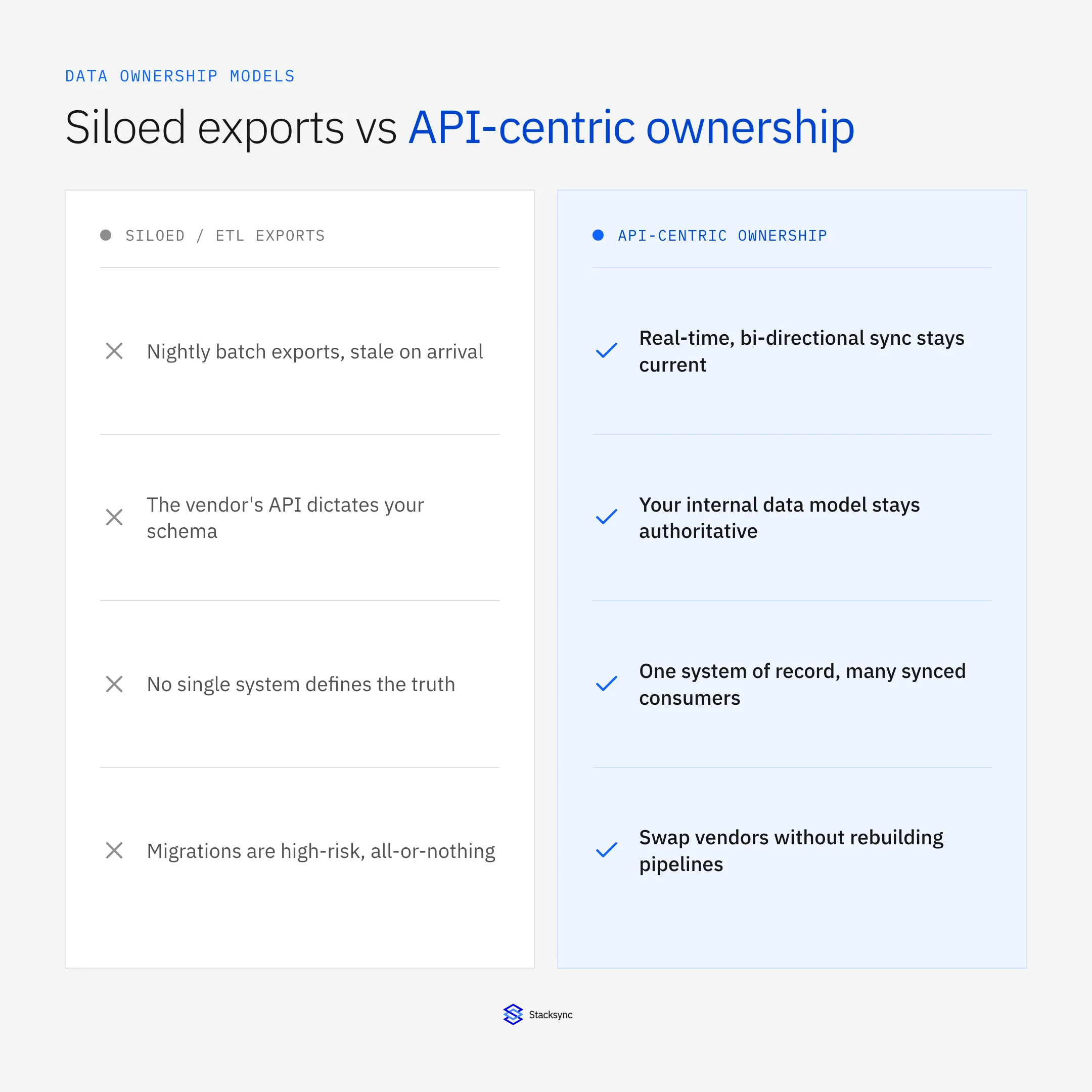
What data ownership means in modern systems
Data ownership is often confused with data storage. Just because a system stores data does not mean it truly owns it.
True ownership includes:
- The ability to read and write data without friction
- Control over data models and relationships
- Visibility into changes and failures
- The freedom to move data when systems change
In API-centric environments, these properties are frequently split across multiple vendors.
How APIs quietly redefine ownership
APIs are designed to expose data safely, not to give full control. As more systems are connected through APIs, ownership shifts away from internal teams.
Common patterns include:
- 01CRMs becoming the source of truth for customer data
- 02ERPs controlling financial and operational records
- 03SaaS tools enforcing rigid schemas and rate limits
- 04Internal services adapting their models to external APIs
Over time, the API provider dictates how data can be accessed, updated, and synchronized.
The illusion of control through integrations
Many teams believe that building integrations means owning their data. In reality, integrations often deepen dependency.
When data flows depend on:
- Vendor-specific APIs
- Rate limits and quotas
- Webhooks with partial guarantees
- One-way sync models
Ownership becomes conditional. Teams can only act within the constraints imposed by each API.
Where ownership breaks down at scale
As systems grow, small limitations become structural problems.
Schema drift and forced compromises
APIs rarely evolve at the same pace as internal models. Teams end up flattening or distorting their data to match external schemas.
This leads to compromises that permanently shape how the business operates.
Latency and eventual consistency
When data moves through asynchronous APIs, real-time ownership disappears. Teams no longer know which system reflects the current state.
Decision-making slows because trust in data erodes.
Vendor lock-in through data gravity
The more critical data lives behind an API, the harder it becomes to leave. Migrations turn into high-risk projects because ownership never fully belonged to the team.
Why data ownership is a business problem
Loss of data ownership is often framed as a technical issue. Its impact is strategic.
- Product teams are constrained by external data models
- Engineering velocity drops due to defensive integration work
- Leadership decisions rely on delayed or partial data
Over time, the organization adapts to its tools instead of the other way around.
Re-centering ownership around your data layer
Modern teams are shifting ownership back to a central data layer that they control. Instead of treating APIs as the primary interface, they treat them as transport mechanisms.
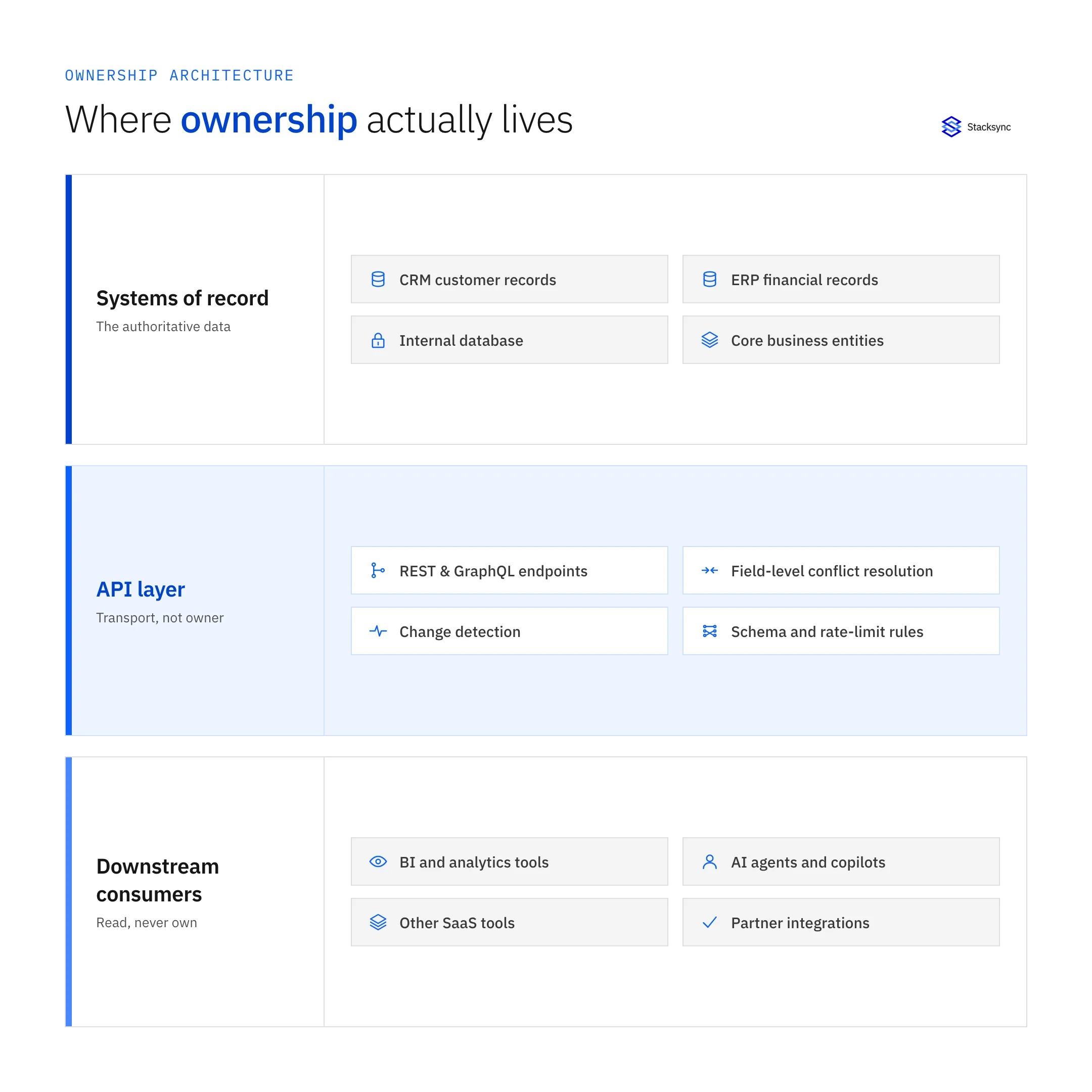
This approach emphasizes:
- A database-first view of core business entities
- Bi-directional data flows instead of one-way exports
- Clear observability into data changes
- The ability to evolve internal models independently
Ownership is restored when internal systems define the truth, not external APIs.
What API-centric ownership looks like in practice
Ownership stops being an abstract idea once you name the three layers explicitly: which system is the system of record, which layer is just transport, and which systems are downstream consumers that should never be mistaken for a second source of truth.
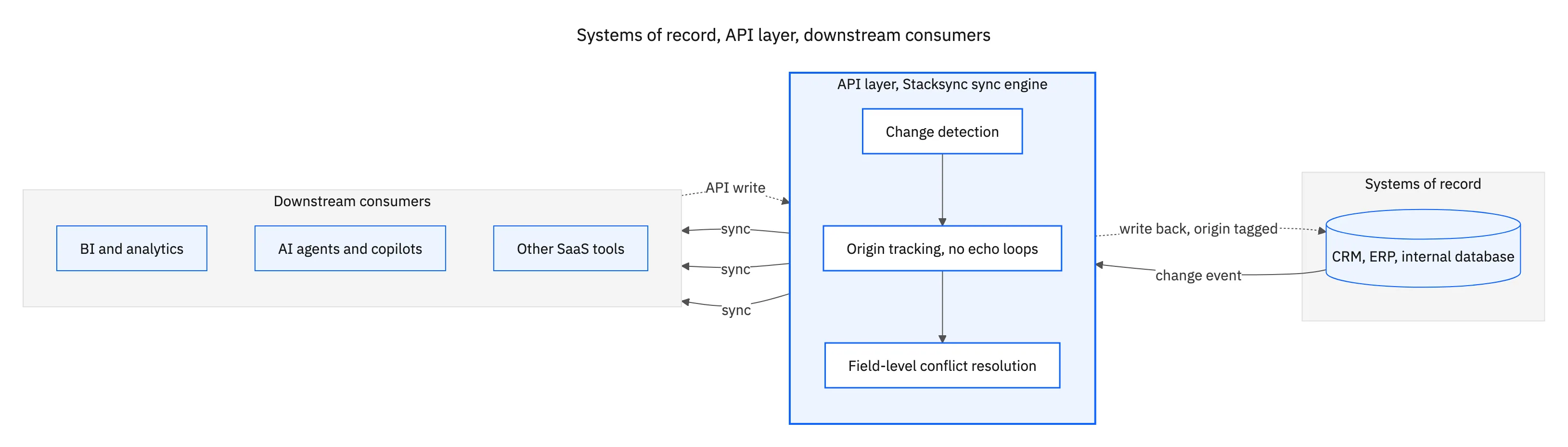
| Layer | What it does | Who should own it | What breaks when it's blurred |
|---|---|---|---|
| Systems of record | Holds the authoritative version of a customer, order, or financial record | The team that owns the business process (sales, finance, support) | Two systems both claim to be the source of truth |
| API layer | Moves data in and out; enforces schema, auth, and rate limits | Platform or data engineering, as transport, not as a data owner | The API's schema and limits start dictating how the business models its data |
| Downstream consumers | Read and act on synced data: BI, AI agents, other SaaS tools | Whoever built the workflow, never as a second source of truth | A consumer's cached copy drifts and nobody notices until a report is wrong |
Consider a team that ran on nightly CSV exports from its CRM into a shared spreadsheet, which finance then re-keyed into the ERP by hand. Nobody could say, at any given moment, which system held the true customer record: the CRM, the spreadsheet, or the ERP. Moving to an API-centric ownership model did not mean adding another export. It meant naming the CRM as the system of record for customer data, putting a sync engine in the API layer so it enforces field-level conflict resolution and origin tracking instead of a person re-typing values, and treating the spreadsheet and the ERP as downstream consumers that read live data instead of stale copies. The nightly batch disappeared. So did the reconciliation meetings.
APIs as pipes, not as owners
APIs are powerful, but they should not define the boundaries of your data. When APIs act as pipes rather than gatekeepers, teams regain flexibility.
This shift allows:
- Faster product iteration
- Safer tool replacement
- Reduced long-term lock-in
The architecture becomes resilient to change instead of brittle.

When regaining ownership becomes a competitive advantage
Companies that control their data move faster. They experiment more. They switch tools with confidence.
Ownership enables optionality, and optionality compounds.
Apply this in consumer packaged goods: ERP mirror row and channel-item crosswalk
CPG master data makes ownership concrete: an ERP item, marketplace alias, pack conversion, and proposed correction serve different purposes. Apply the ownership model to an operational database that can expose shared evidence without treating every database edit as permission to change an accepted ERP record.
| Record to reconcile | Responsible owner | Rule to preserve |
|---|---|---|
| ERP mirror row | ERP administrator | Preserve the NetSuite internal reference and source revision; restrict edits to finance-owned values. |
| Channel-item crosswalk | Product operations | Key each alias by channel, account scope, item, and effective period. |
| Proposed correction | Data steward | Record the requested value, reason, requester, review status, and affected records separately. |
An exception to plan for: Alias overlaps two products. Suspend the ambiguous mapping and ask the steward to establish scope and effective dates. Acceptance check for the pilot: historical orders retain the correct mapping revision.
The consumer packaged goods hub connects the broader operating context. These guides develop the specific record mappings and decisions for this application:
A practical path forward for API-centric teams
Reclaiming data ownership does not require abandoning APIs. It requires rethinking how data flows between systems.
When teams introduce a real-time, bi-directional data layer that sits between APIs and internal systems, ownership shifts back where it belongs.
This is where platforms like Stacksync quietly change the equation. By keeping systems synchronized in real time while letting teams work directly with their own data models, Stacksync turns APIs into infrastructure rather than points of control.
Instead of adapting your business to API limitations, you regain ownership of your data and the freedom to build without friction.

FAQ
Frequently asked questions










Related articles